
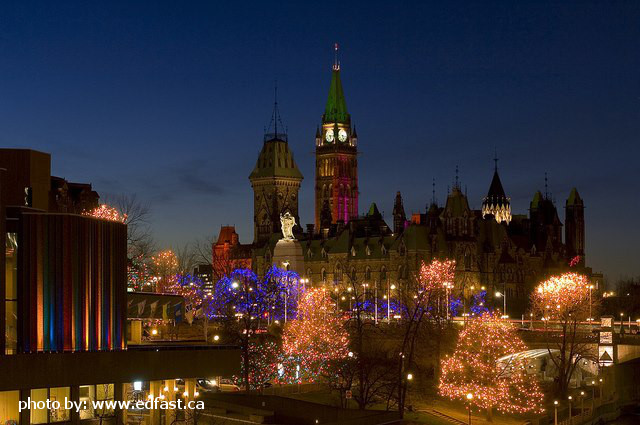
Confederation Square in Ottawa is just to the southeast of Parliament Hill in Ottawa, between “The Hill”, The National Arts Centre, The Government Conference Centre (formerly the Ottawa Railway Station) and The Chateau Laurier Hotel – in short it’s in the middle of everything…and a short walk to some magnificent scenery, unimaginable shopping and other activities.
[the photo below shows the National War Memorial, the Centre of the Square, with the Parliament Buildings in the back ground, the National Arts Centre to the left foreground of the shot and to the right out of the shot are the Chateau Laurier Hotel and The National Conference Centre.]
The centrepiece of the square is the National War Memorial and the Tomb of the Unknown Soldier.
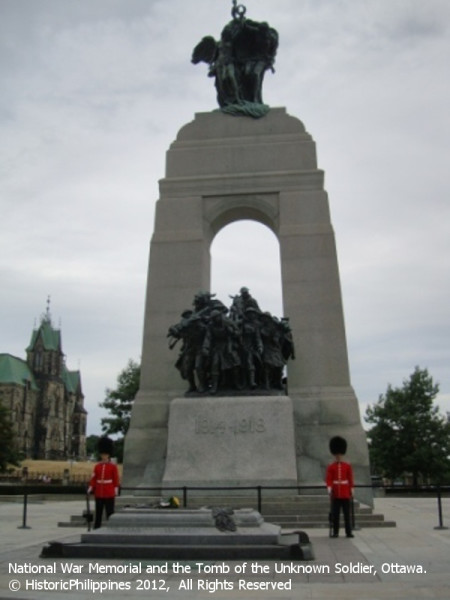
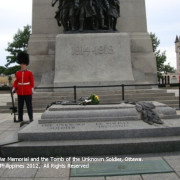
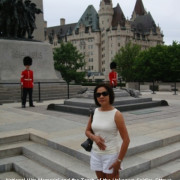
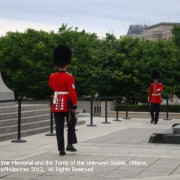
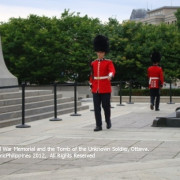
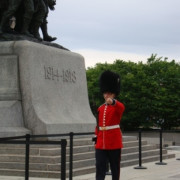
The Ceremonial Guard is mounted by the Regiment of the Governor General’s Footguards and they stand vigil over the Tomb of the Unknown Soldier.
The Canadian Tomb of the Unknown Soldier (Tombe du Soldat Inconnu) is located at the National War Memorial in Confederation Square, Ottawa.[1] The Tomb of the Unknown Soldier was added to the war memorial in 2000, and holds the remains of an unidentified Canadian soldier who died in France during World War I. The unidentified soldier was selected from a cemetery in the vicinity of Vimy Ridge, the site of a famous Canadian battle of the First World War. The Tomb of the Unknown Soldier was created to honour the Canadians whether they be navy, army, air force or merchant marine, who died or may die for their country in all conflicts – past, present, and future.
The body of the soldier was formerly buried in Plot 8, Row E, Grave 7, of the Cabaret-Rouge British Cemetery in Souchez, France, near the memorial at Vimy Ridge, the site of the first major battle where Canadian troops fought as a combined force. At the request of the Canadian government, the Commonwealth War Graves Commission selected one of the 1,603 graves of unknown Canadians buried in the vicinity of Vimy Ridge. The remains of the soldier were exhumed on the morning of May 16, 2000, and the coffin was flown in a Canadian Forces aircraft to Ottawa on May 25, accompanied by a guard of honour, a chaplain, Royal Canadian Legion veterans, and representatives of Canadian youth. In Ottawa, the unknown soldier lay in state for three days.
On the afternoon of May 28, the body of the unknown soldier was transported from Parliament Hill to the National War Memorial on a horse-drawn gun carriage provided by the Royal Canadian Mounted Police (RCMP). Governor General Adrienne Clarkson and Prime Minister Jean Chrétien, as well as veterans, Canadian Forces personnel, and members of the RCMP, were in the funeral procession. Then, with appropriate ceremony, the body of the unknown soldier was re-interred in a sarcophagus in front of the War Memorial.
At the former burial site of the unknown soldier, a grave marker similar to the other headstones in the Cabaret-Rouge Cemetery has been placed on the now-empty grave. The marker is inscribed with these words:
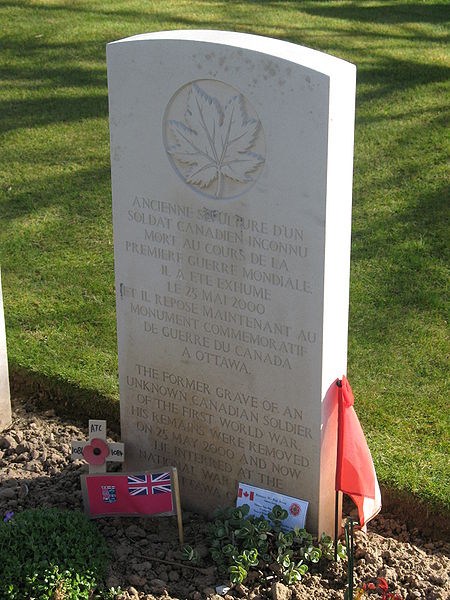
This is a photo of the stone in place at the former grave site (in the Cabaret Rouge Cemetery, just south of Souchez, France) of the Canadian unknown soldier now entombed at the National War Memorial in Ottawa.
Date April 2007 Source Own work (I took this photo) Author D.D. MacKinlay
The National War Memorial (also known as The Response), is a tall granite cenotaph with accreted bronze sculptures, that stands in Confederation Square, Ottawa, and serves as the federal war memorial for Canada.
Originally built to commemorate the First World War, in 1982 it was rededicated to include the Second World War and the Korean War. In 2000, the Canadian Tomb of the Unknown Soldier was added to the memorial site and symbolizes the sacrifice made by every Canadian who has died or may yet die for their country.
A competition was held in 1925 to seek designs for a national war memorial to be dedicated to the First World War. Entrants were limited to residents of the British Empire who were British subjects, or who were citizens of allied nations. The competition received 127 entries, of which seven were asked to provide scale models for final judging. The winner, announced in January 1926, was Vernon March, from Farnborough, United Kingdom. His theme was to represent the response of Canada to war, symbolised by service people from all disciplines marching through a triumphal arch, but with a deliberate aim to avoid the glorification of war.
Symbolically, two 5.33-metre-high (17.5 ft) allegories of peace and freedom stand at the apex of the arch, their proximity to each other representing the inseparability of the two concepts, under which the depictions of 22 Canadian service-men, from all branches of the forces engaged in the First World War in historically correct uniforms, move towards the call of duty. To avoid foreshortening from a pedestrian viewpoint, the group of figures is placed at a specific height above street level; each body is approximately 2.4 metres (7.9 ft) high. At the front are infantrymen; to the left a Lewis gunner, to the right a kilted soldier with a Vickers machine gun. Following these are a pilot in full gear, an air mechanic, and a sailor. Both a cavalryman and a mounted artilleryman are emerging from the arch, side by side, followed by two riflemen pressing through the arch, and behind them are the men and women of the support services, including nurses, a stretcher bearer, and a lumberman. All of these are affixed to a pedestal executed in rose-grey Canadian granite from the Dumas Quarry at Rivière-à-Pierre, Quebec.
Work began in 1926 under the auspices of the Dominion’s Department of Public Works. March was assisted by his six brothers and his sister, all of whom completed the work after March’s death in 1930. The sculptures were first produced in clay, from which moulds were made, and the bronze was then cast in the Marchs’ foundry; this work was finished in July 1932, and after a period on display in Hyde Park, London, and in storage in the foundry, they were relocated to Ottawa in 1937.
On 21 May, the memorial was officially unveiled by George VI, king of Canada, in the presence of an estimated 100,000 people, months before the Second World War began.
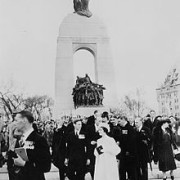

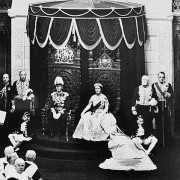
The memorial, from grade to the tip of the surmounting statues’ wings, is approximately 21.34 m (70 ft), with the arch itself 3.05 m (10 ft) wide, 2.44 m (8 ft) deep, and 8.03 m (26 ft 4 in) high. The lowest step of the pedestal is 15.9 m (52 ft 2 in) by 8.08 m (26 ft 6 in). 503 tonnes of granite and 32 tonnes of bronze were used, all of which rests on a block of reinforced concrete based on steel columns set into bedrock.
The memorial features 23 bronze figures, representing people who fought in the First World War, emerging from a memorial arch, moving from war into peace. Overhead, winged figures symbolize peace and liberty. The dates commemorating the Second World War (1939–1945) and the Korean War (1950–1953) were added in 1982. Canada’s Unknown Soldier, who fell in France in 1917 and was originally buried in that country, was exhumed and re-buried at the base of the memorial before Governor General Adrienne Clarkson, veterans, and other dignitaries and a large crowd on 28 May 2000.
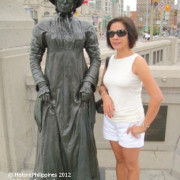
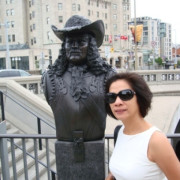
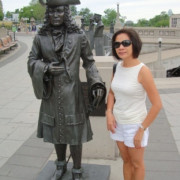
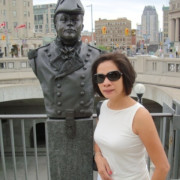
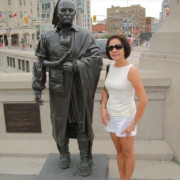
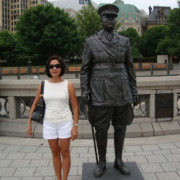
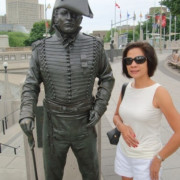
On the east side of the memorial is a series of bronze statues and busts depicting important characters in Canadian history including:

 (0)Dislikes(0)