

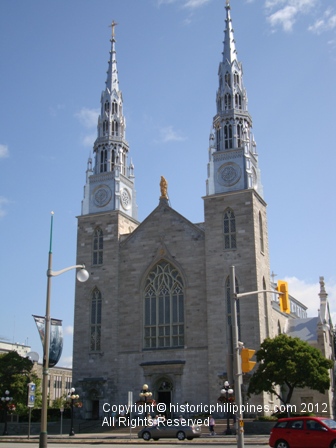
The Roman Catholic Basilica, Notre Dame in
Canada’s Capital City, Ottawa
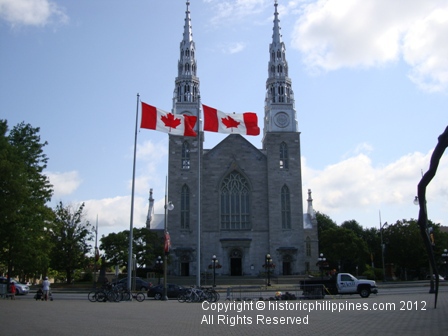
We just returned from a summer vacation with our family in Canada. In keeping with the work we do here in Philippines I decided that it would be really interesting to visit the Roman Catholic Basilica Notre Dame in Ottawa, the Canadian National Capital and my hometown.
Although Notre Dame is not our home parish, it has become a family tradition to attend mid-night mass on Christmas Eve at the Basilica each year. It is one of the most beautiful churches it has ever been my privilidge to visit.
The original plans for the Church were drafted in 1839 and construction work was started in 1841, with the exterior being completed in 1865 and the interior between 1876 and 1885. The church was built in the Gothic style.
The Church is truly breathtakingly beautiful!
According to historical records, a first mission was established in Bytown (original name of Ottawa) in 1827 with the first wooden Chapel being erected in 1832. Bytown was then under the Diocese of Kingston.
At the front of the Church, next to the altar of the Sacred Heart, on the left (north) side of the Basilica, is the cornerstone that was laid in 1841.
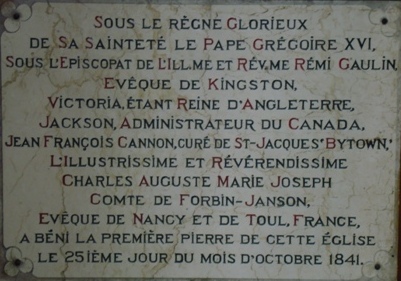
The message on the stone when translated to English reads as follows:
“Under the glorious reign of Pope Gregory XVI and the Episcopate of Rémi Gaulin, Bishop of Kingston, Victoria being Queen of England, Jackson, Administrator of Canada, Jean-Francois Cannon, Parish Priest of St James of Bytown, Charles August Marie Joseph, Count of Forbin-Janson, Bishop of Nancy and Toulouse, France, has blessed the corner stone of this church this 25th day of October 1841.”
The Oblates of Mary Immaculate took over the parish in 1844 and that is basically when the project really took flight.
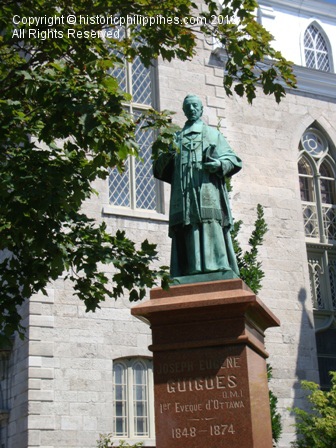
Joseph-Eugene-Bruno Guigues, OMI,
First Bishop of Bytown (Ottawa)
Notre Dame Cathedral of Ottawa is a masterpiece created entirely by our architects and sculptors. It belongs to a class of wooden and stone churches which bears witness to a fine building tradition, and it ranks among some of the inspired works whose great beauty comes as much from their magnificence as from the profound faith of the artisans who crafted them.
In 1847, Bytown, which as mentionned earlier had been under the Diocese of Kingston, by order of Pope Gregory XVI was made a Diocese in its own right. The first Bishop named was: Joseph-Eugène-Bruno Guigues, OMI. The poor mission church was prematurely transformed into a cathedral. With the growth of the diocese under the second Bishop of Ottawa, Most Reverend Thomas Duhamel, and with the impetus of a visionary artist, Canon Georges Bouillon, the cathedral was finally completed in 1885. Dedicated to the Immaculate Conception in 1853, Notre Dame Cathedral was elevated to the status of basilica in 1879. In 1999, the Cathedral underwent a major restoration. This was the first phase of a multi-year project.
The cathedral is indeed the oldest surviving church in Ottawa. It stands on the site that was occupied by the first Catholic chapel open to both anglophones and francophones of Bytown.
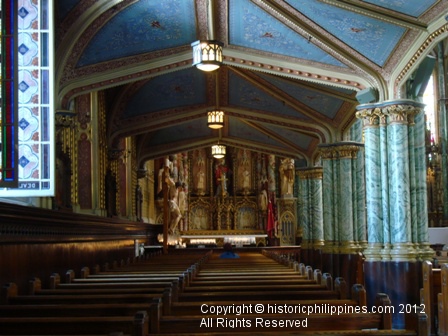
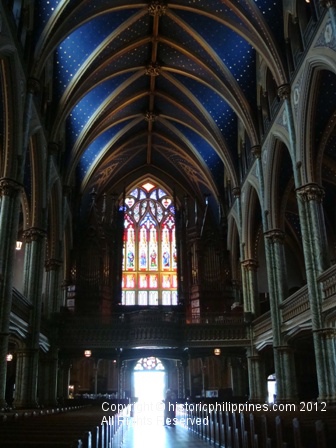
The spaciousness, majesty, and sacred character of the interior of this cathedral strike the visitor just as they did a hundred years ago. In the reigning dimness, one soon makes out the long, narrow, and high central nave, with its line of imposing Gothic arches running from the entrance all the way to the main altar. On each side, bundles of slender columns divide the nave from the aisles. Supported by these columns and covering the side aisles are terraced galleries that look out into the nave and help to define its vastness. Above these large arches runs a blind arcade, with three arches per span, which accentuates the rhythm of the nave. Over each segment stands a high window. In the sanctuary, the large arches progressively open up to a view of the windows set in behind them, the blind arcades display their theatrical decor and the high windows look like beams of light beneath the imposing sculpted flowerlet that terminates the lierne and unites the ribbing of the apse in a crown above the main altar.
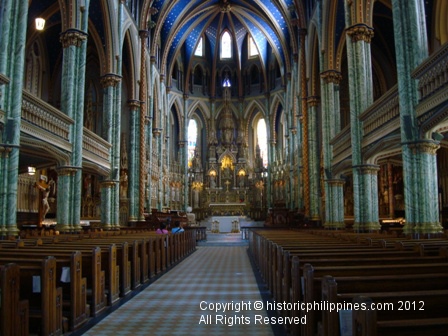
The Nave of the Basilica leading up to the ornate Sanctuary
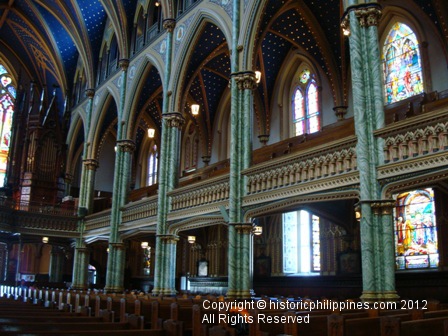
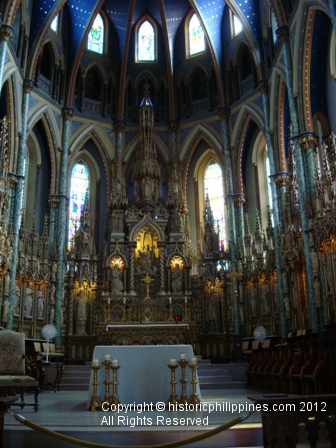
The Sanctuary seen from the Transcept
The most striking aspect of this sanctuary is the richness of its Gothic ornamentation and the originality of its iconography. The study of the decorations and the sculptures of the sanctuary amply display the creativity and the spirit of Canon Bouillon. Bouillon was inspired by medieval tradition and the neo-Gothic movement, his iconography is at once complex, coherent, traditional and innovative. Although it has a traditional air, it bears the markings of its nineteenth century central-Canadian roots. The sanctuary of Notre Dame of Ottawa permits us to enter into the circle of a great assembly of patriarchs, prophets, apostles, and saints gathered around Christ, amidst the angels, in the glory of the heavenly Jerusalem.
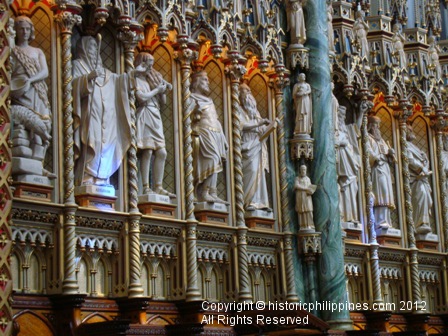
Bouillon’s statuary is truly impressive, especially in the area of the Sanctuary
In different niches of honour, we recognize Saint Joseph, the patron saint of Canada, as well as Saint John the Baptist, and St. Patrick, patron saints of the Archdiocese of Ottawa.
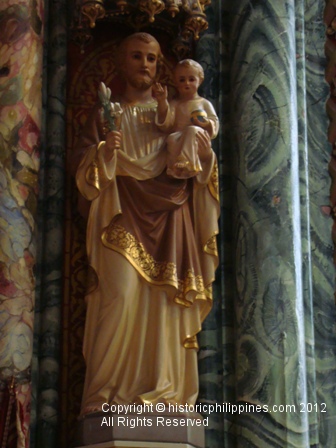
St Joseph, Patron Saint of Canada, an example of one of the three statues mentioned above
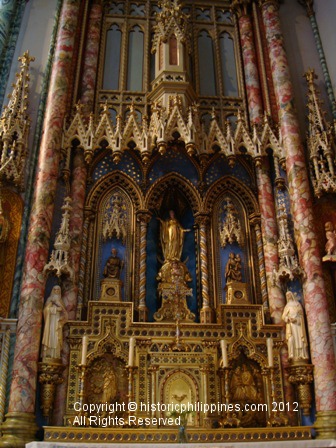
At the entry to the sanctuary, in the two lateral rows joining the nave’s side aisles, have been erected secondary altars of sculpted wood, covered with gold leaf and decorated with precious stones; they are rather like the shutters of a giant triptych of azure and gold. The altar located on the left side of the sanctuary was built in 1879 and dedicated to the Sacred Heart. The other one, on the right-hand side, dates from 1885 and is consecrated to the Virgin Mary; it is the most splendid of this church’s three altars, and Canon Bouillon’s final work in the cathedral. The artistic work of Canon Bouillon is truly breathtaking!
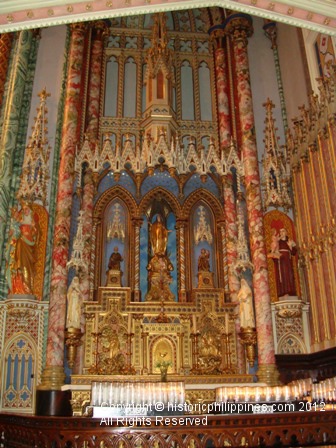
The altar dedicated to the Blessed Virgin
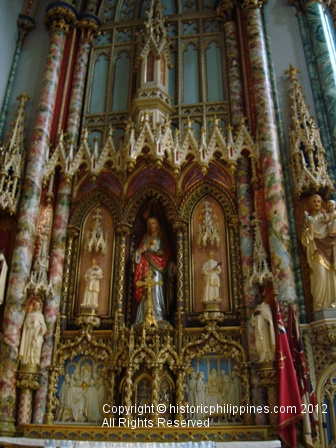
Altar dedicated to the Scared Heart, dating to 1879
The stained-glass windows installed in the cathedral dates 1879. Made by the English glassworker Horwood, these windows consist of geometrical motifs painted in grisaille and embellished by light touches of vivid colours. Most of them were replaced between 1956 and 1961 by a series of 17 historiated windows, made by the artist Guido Nincheri of Montreal, telling of the mysteries of Christ’s life and that of the Virgin Mary. Of particular prominence is the large window located just above the cathedral’s main entrance. The tall figures painted in the center of this window represent, from the left to right: St. Patrick, St. Paul, the Virgin Mary, St. Joseph, St. Peter, and St. John the Baptist.
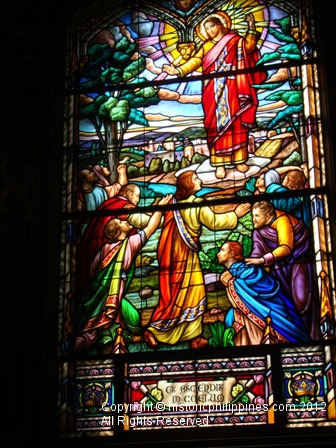
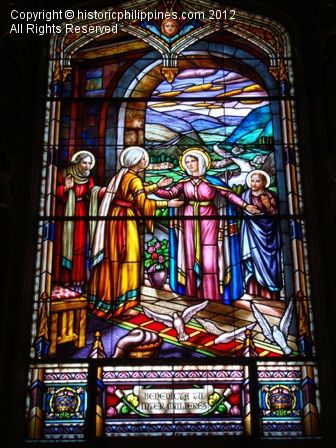
The reredos of the sanctuary, 15 meters high, is a masterpiece of craftmanship conceived by Canon Bouillon and realized by talented cabinetmakers like Flavien Rochon and Philippe Pariseau. In the centre of the reredos: Christ in Glory.
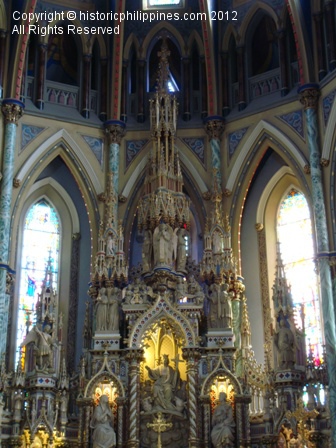
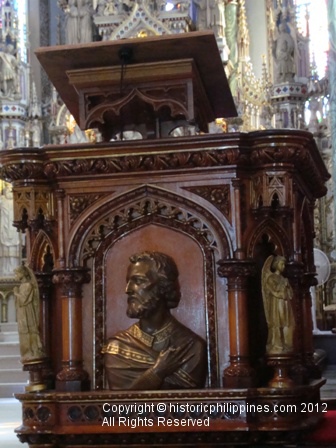
The pulpit (or ambo), which is now at the entrance of the sanctuary was, when built in 1884-1885, standing against a column of the nave. This pulpit is decorated with two figures of evangelists and four small statues of angels. These wooden sculptures were bought in France, in 1884, by Canon Bouillon for exactly $146.71.
The episcopal seat (the cathedra) is a gift offered by the Union Saint-Pierre, in October 1874, to Most Reverend Thomas Duhamel, on the occasion of his consecration as second Bishop of Ottawa.
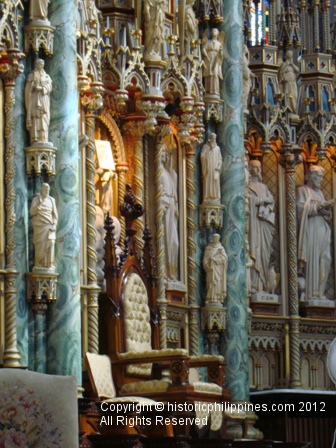
The is the “Cathedra” it is the Archibishop’s teaching chair. When he speaks on matters of faith, he does so “Ex Cathedra” or from the teaching chair…
The ornamental ensemble of the sanctuary conceived by Canon Bouillon was realized between 1876 and 1885 by a team of craftsmen, carpenters, and sculptors, the most familiar being Philippe Pariseau, Flavien Rochon, Olindo Gratton, and Philippe Hébert. Often the same men who laboured at the cathedral site also worked on the Parliament Buildings. Most of these men lived nearby and were either parishioners or fervent admirers of Bouillon, although some were total strangers to the city, such as Philippe Hébert, a Montreal artists whom Bouillon summoned in 1879. At that time this young sculptor had neither a job nor prospective employment and was planning to move to the United States. He later became famous throughout Canada for his monumental bronze sculptures, and the cathedral prides itself on having more than sixty of his wooden sculptures: his greatest sculptural ensemble.
The following photos show some of the marvelous works of this group of artists.
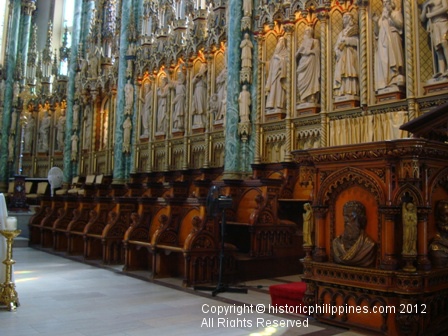
Bouillon’s statuary is truly impressive, especially in the area of the Sanctuary
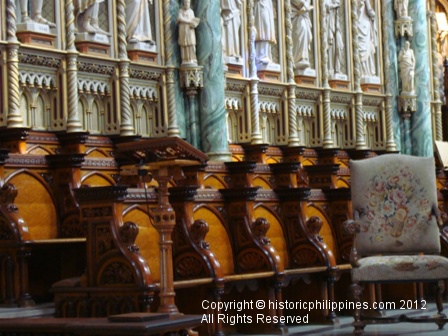
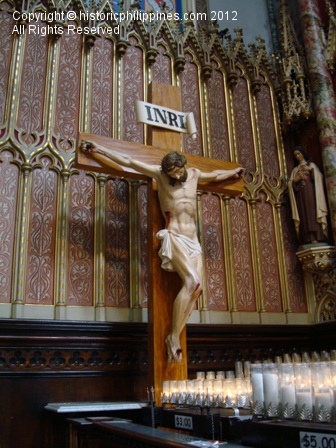
The fifty-two stalls of the sanctuary, in the past reserved to priests and dignitaries, were built in 1883-1884. Carved by Philippe Pariseau, Flavien Rochon and his son Alphonse, these stalls are renowned for the originality of their floral motifs, and their elegance
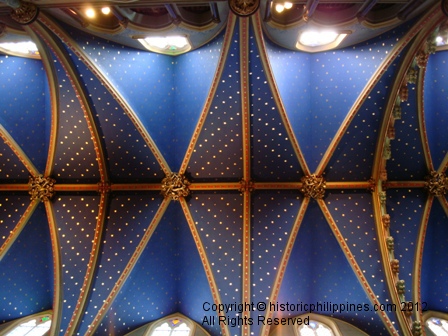
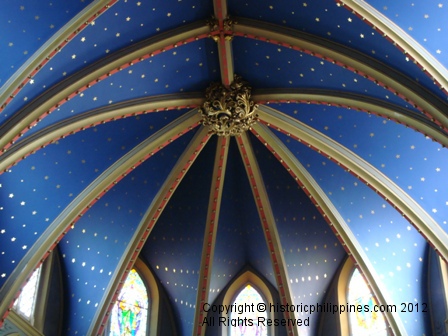
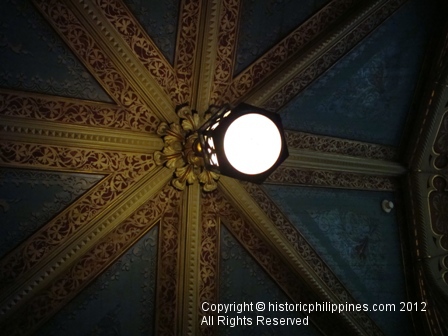
Finally, we were impressed by the ceilings in the cathedral, all were refinished in the late 1990′s and are as fresh today as they were in the 1870′s and 1880′s…
This, is in my opinion, one of the most beautiful, if not the most beautiful church we have ever visited…it is well worth exploring if you every have the opportunity to be in Ottawa, Canada’s Capital City. If you visit Ottawa, then this is a must see!
[Sincere thanks are due to: Father Paul McKeown, OSM, the Rector of the Basilica as well as Mrs. Diane Lemieux-Trudel who is the Secretary for the Diocesan Offices. Both Father McKeown and Mrs Lemieux-Trudel went out of their way to help us in our quest and provided permission for us to use many of the materials contained in the Basilica's website. Thank you both for everything!]
To obtain more information on Notre Dame Basilica in Ottawa please visit their website at: www.notredameottawa.com

This work is licensed under a Creative Commons Attribution-ShareAlike 3.0 Unported License.
 (0)Dislikes(0)