

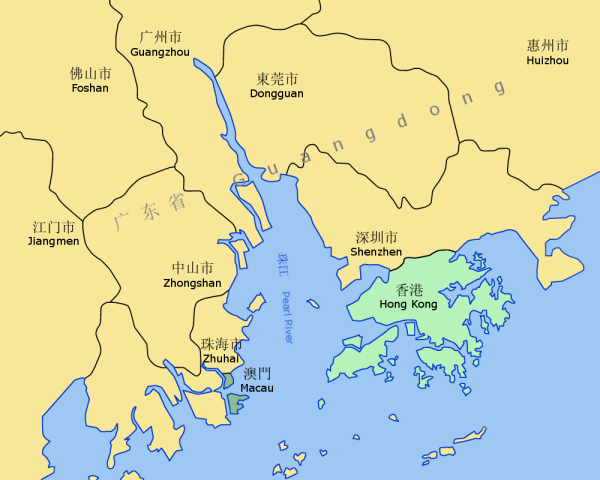
The distance from our jumping off point at the SM City parking lot in Iloilo to Hong Kong is approximately 1,570 kilometres, which translates into 5 to 5½ hours by air.
The Church has finally arrived!
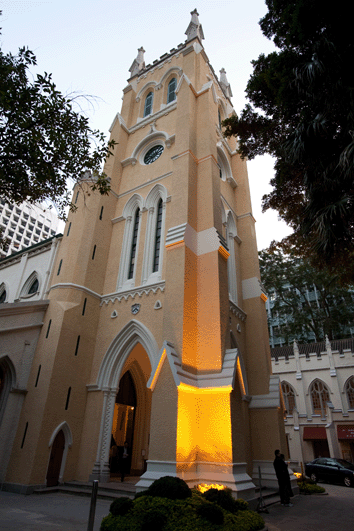
photo by: stjohnscathedral.org.hk
Our principal reference for this report on St John’s Cathedral in Hong Kong is the book titled: The Story of St John’s Cathedral by Stephen Vines, published by FormAsia, Hong Kong in 2001.
Both the Mr. Vines and FormAsia, have granted us permission to use their copyright materials in this article. We are sincerely appreciative of that and thank them both for allowing us to do so.
And now, without further ado, here is St John’s Cathedral, Hong Kong.
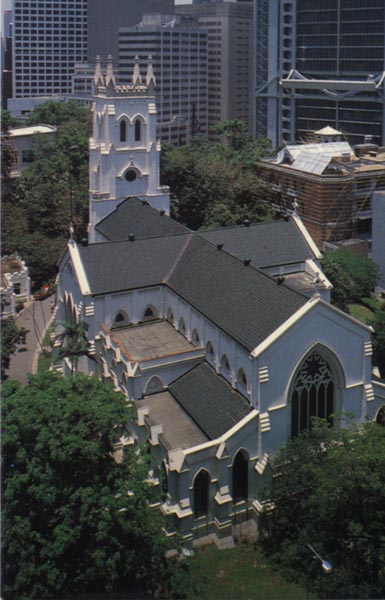
photo by: stjohnscathedral.org.hk
But, before we get going on our visit I have two surprises in store for you, today.
The first surprise is that this is the second significant church we report on that is not in the Philippines. You will recall that we reported on Notre Dame Basilica in Ottawa, Canada, my hometown, following our vacation at home in July of last year.
St John’s Cathedral in Hong Kong has very close ties to the Philippines. Several years ago it was decided that the Church should be involved in helping migrant workers, principally Filipinos who are Hong Kong’s largest group of domestic helpers.
Through its Mission to Filipino Workers, the Church established a self help group which helps migrant workers with counselling, support, and practical advice for those OFWs who face problems in the “alien environment” of Hong Kong. As a result, one of the largest component groups of the church’s congregation is made up of members of the Hong Kong’s Filipino community.
The second big surprise is that this is an Anglican Church and not a Roman Catholic Church like all the ‘others’ we have reported on so far.
That’s right an Anglican Church and a Cathedral at that, with a huge number of its parishioners being Filipino Roman Catholics…interesting, eh?
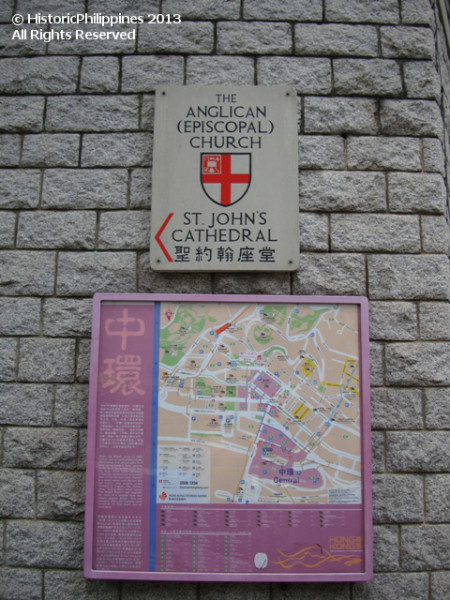
This, therefore, is the abbreviated story of St John’s Cathedral in Hong Kong.
The original church which was “little more than a shed”[1] which had been used for church services since 1842 was replaced starting with the laying of the cornerstone on the 11th of March 1847. Even though the cornerstone had been laid, that didn’t mean that construction actually got underway at that time.
There was an on-going struggle to raise the funds needed to build the church. The church was built in the gothic style much the same as many of the British churches of that time.
The Governor of the time, Sir John Davis was one of the prime movers insisting on the need to have a proper Cathedral to replace the ‘shed’ that had been in use since there early 1840s. The community struggled hard to raise the funds needed and finally raised ₤4,136 sterling but needed a matching grant from London to pay the full cost of ₤8,376[2]. This was to be a very high cost at the time when you consider that the average cost of building a church in Britain was only about ₤3,000[3].
Yet, the most interesting aspect of the Cathedral is the fact that it is ‘situated on the only piece of freehold land in Hong Kong. Now that Hong Kong is a Special Administrative Region of the People’s Republic of China, it also has the distinction of being on the only piece of freehold property in China. Chinese law, does not recognize the concept of freehold land although the Church’s ownership of the site is enshrined in law. All other land in the former colony is leased from the government. The fact that the freehold was in fact granted say quite a bit about the position and strength of the church in early colonial days[4].’
Unlike many of the other ‘denominations and churches’ in Hong Kong which were most involved in missionary work, St John’s was primarily catering to the expatriate Christians who were already part of the Christian community[5]. As early as 1847 the church was involved in educating Chinese children which effectively started a process that created a number of prestigious and influential Chinese schools affiliated with the Church. The first, which became St Paul’s College, was founded in 1850 and to this day remains as one of Hong Kong’s leading schools. Over 100 schools are attached to the church ranging from kindergartens to primary and secondary schools, and one of the colleges at the University of Hong Kong[6].
In addition, the church concentrates a great deal of its efforts on outreach to the poor and disadvantaged and those suffering from social injustice. The efforts of the church in its outreach programs have lead to condemnation and misunderstanding in the community. As examples: in the mid-1990’s the church organized an AIDS counselling centre on the grounds of the Cathedral. In addition, more than a few eyebrows were raised when the Cathedral decided to get involved in helping migrant workers, primarily Filipinos who form Hong Kong’s largest community of domestic helpers. As such they belong to a group most likely to suffer discrimination and ill treatment. The Mission to Filipino Migrant Workers is a self-help group supported by the church[7].
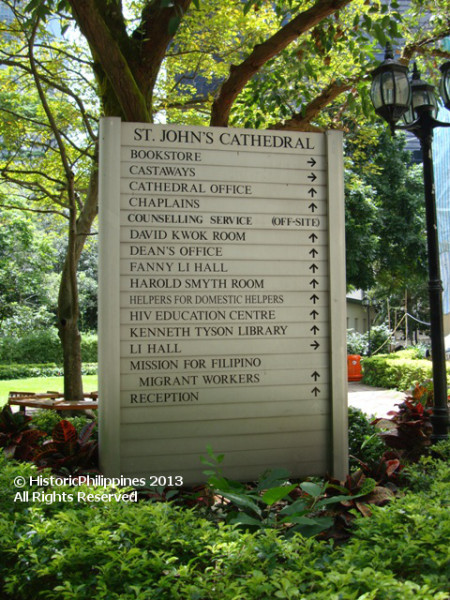
The Cathedral today.
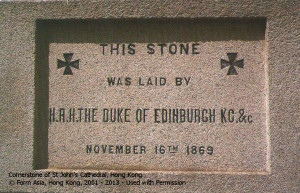
The building you see today was completed in 1849 and extended in 1873. In fact, reminiscent of its very early days the cornerstone for the east wing was actually laid by HRH The Duke of Edinburgh in November of 1869 and the work on the extension was only completed in 1873.
The church is a cross-shaped structure was created in the styles of 13th century Early English and Decorated Gothic styles.
The church’s tower was added in 1953. It is about nine stories tall and was a gift to the Cathedral on the occasion of Queen Elizabeth II’s coronation by the Hong Kong Bank. The main entrance of the church is ‘under’ the bell tower.
[left click on any photo to view in larger format]
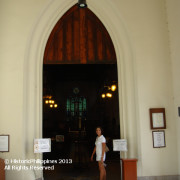
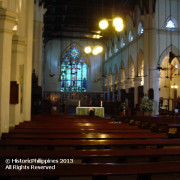
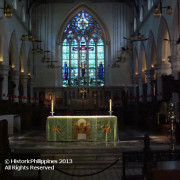
On entering the church we arrive in a small vestibule or narthex, which as is traditional is fairly dark with the only light coming into it from the exterior the massive wooden doors or from the main body of the church. In the classical style of a Cathedral, the church has wide central aisle leading to the apse featuring the main altar. There are two other aisle on either side of the main central aisle leading to smaller chapels at their end.
In the vestibule we note the rather prominently displayed description of the iconography of the church specifically two icons in particular. They are:
[left click on any photo to view in larger format]
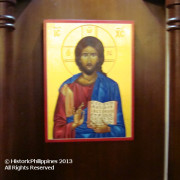
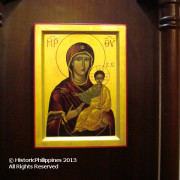

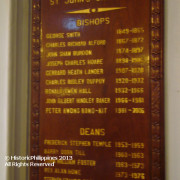
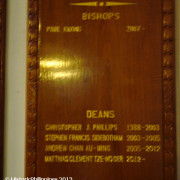
Next to the descriptions of the Icons are two plaques listing the Bishops and Deans who served the congregation since its founding in 1849.
[left click on any photo to view in larger format]
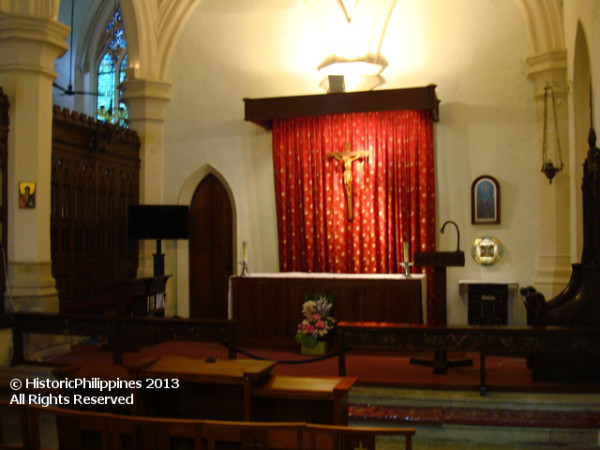
As we mentioned earlier the side aisles lead to smaller chapels. On the south side of the church is the Chapel of St Michael’s which is quite interesting in itself. It should be noted also that just before entering this Chapel, there is a small sign stating: “This chapel is private prayer and meditation. The Blessed Sacrament is reserved here. Please be quiet and reverent.”
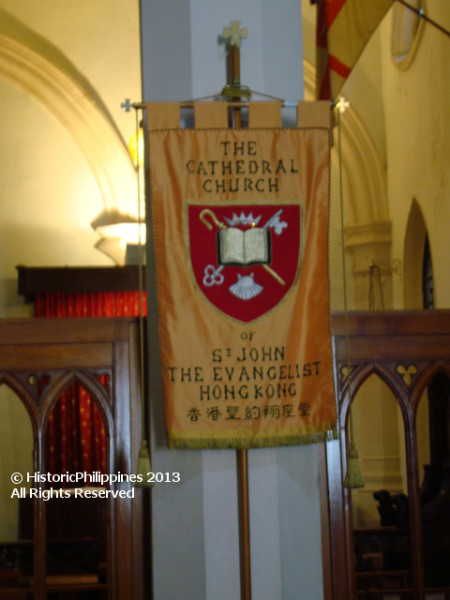
Hanging from the ceiling on either side of the chapel are a series of battle flags commemorating various units of the British and Commonwealth armies who fought and died valiantly trying to defend Hong Kong during the Japanese invasion at the beginning of World War II. In addition, the walls on the north side of the chapel have a series of plaques commemorating certain other units that fought and died in the battle of Hong Kong and during the entire span of World War II.
[left click on any photo to view in larger format]
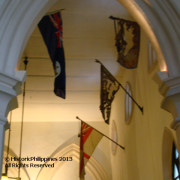
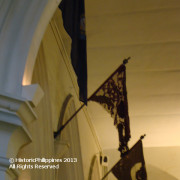
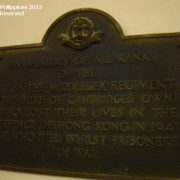
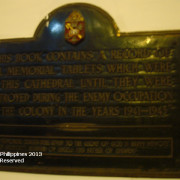
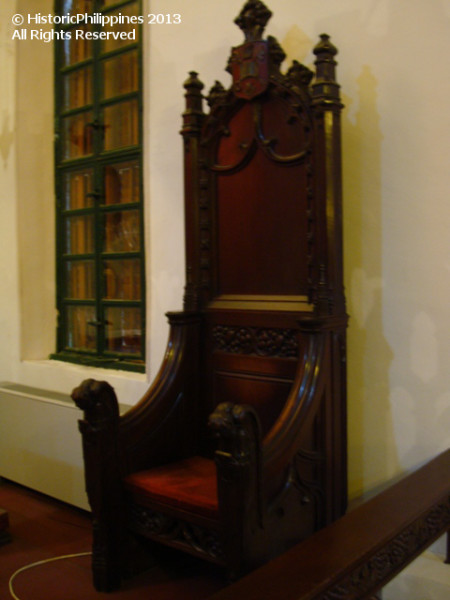
The chapel also ‘houses’ the Bishop’s Throne.
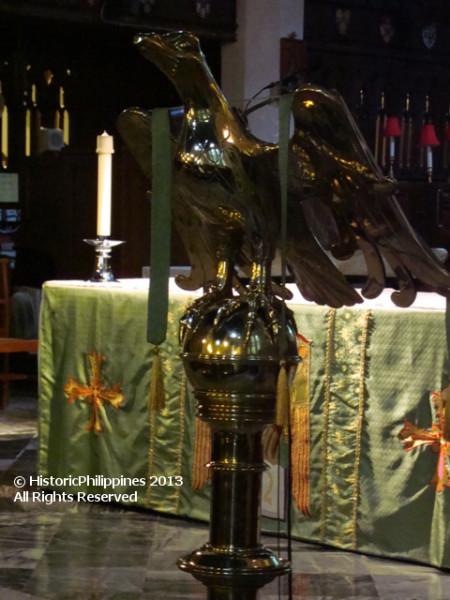
As we exit St Michael’s Chapel and re-enter the main church and proceed north along the transcept we note the magnificent lectern just inside the ‘communion rail’, next to the main altar. It is massive and appears to be made of gold…in the shape of an eagle.
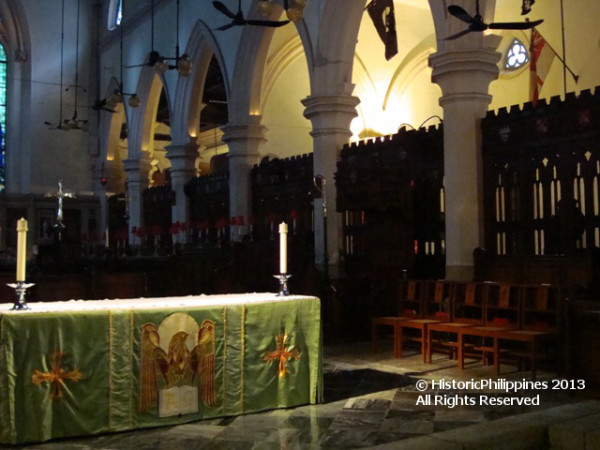
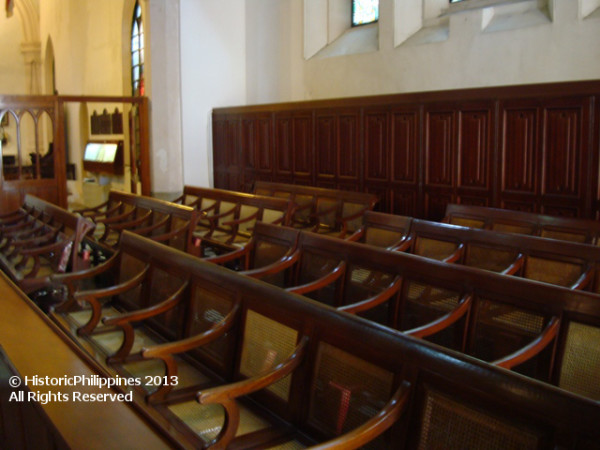
Also in the Sanctuary we note the beautiful choir pews with what appears to be rattan backs and seats..
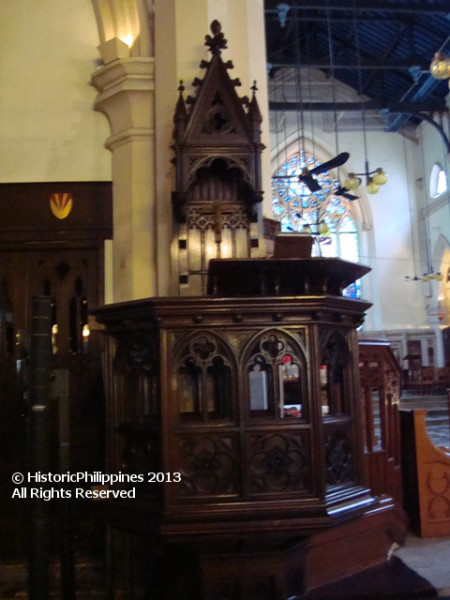
Across the sanctuary on the north side, we find the beautifully carved pulpit, which is said to have been donated to the Cathedral by Hong Kong’s eleventh Governor Sir William Robinson (1891 – 1898).
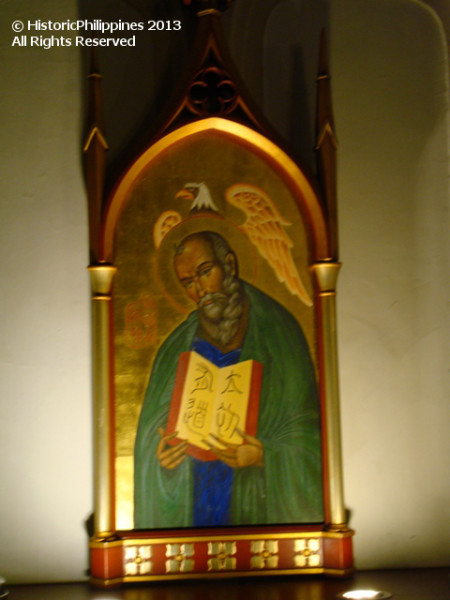
Immediately to the left of the pulpit there is a second chapel which is dominated by a superb ICON, which to me, appears to be an Icon of one of the evangelists – perhaps is it St John the Evangelist?
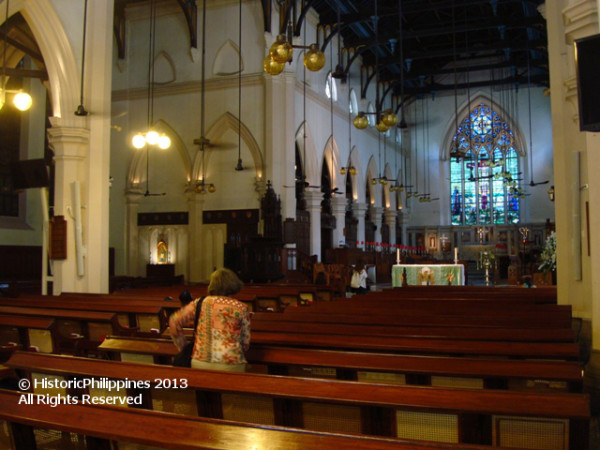
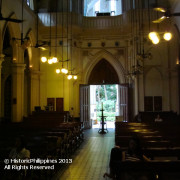
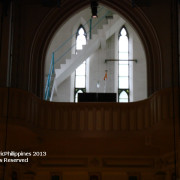
As we glance towards the back of the church and the main entrance, I am surprised to see how high the “organ loft” is in this church, it appears to be at least 5 or 6 stories above the floor of the church. The arches along both side aisles are also a beautiful touch…give the church and air of majesty.
[left click on any photo to view in larger format]
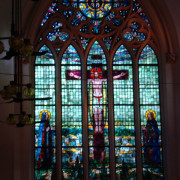
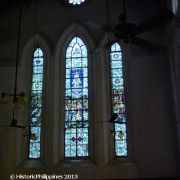
I am also impressed with the stained glass windows. The occupation of the church during the World War by the Japanese resulted in all of its original stained glass windows being removed and or destroyed by the occupiers. They have all been replaced since and they are considered to be artistic treasures. Here are two examples.
[left click on any photo to view in larger format]
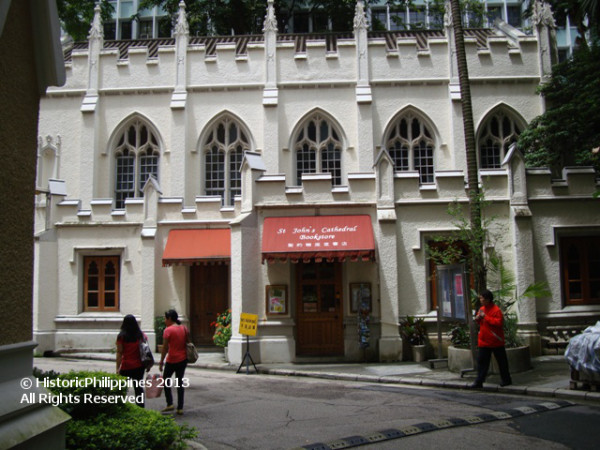
As we exit the church to the south of the main entrance is the Cathedral bookstore…
And if we head north towards the Battery Pathway, we notice in the yard beside the Court of Final Appeal the massive Celtic Cross. The cross was originally unveiled by Governor Sir Reginald Stubbs, in 1921 in memory of the soldiers killed in World War I. During the Japanese occupation the cross was reduced to a straight granite column. In 1952 it was replaced by the Celtic Cross, with an inscription added to commemorate those who had died in both World Wars. The original bronze tablet with the names of the First World War dead is held inside the cathedral, in the Chapel of St. Michael. Beside the Memorial Cross is a tombstone covering the remains of Pte. R. D. Maxwell, who was killed in Wan Chai 3 days before the ceasefire. It is the only grave within the cathedral precinct and is registered by the Commonwealth War Graves Commission.
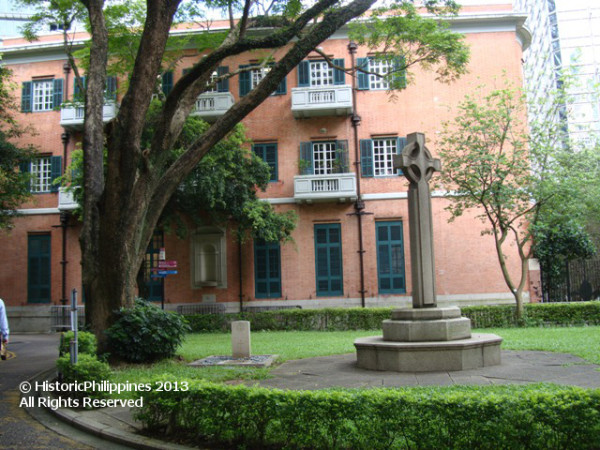
Finally, in 1996, the Cathedral was made a DeclaredMonument (#60) of Hong Kong.
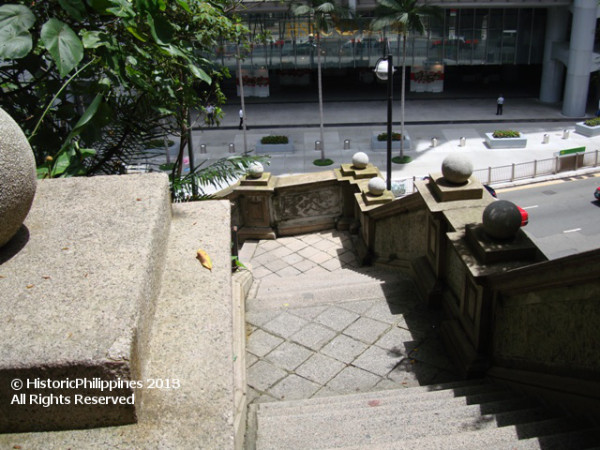
As we reluctantly leave this oasis of peace and tranquility and head back into the hustle and bustle of the city below, we find a series of stone steps we missed, along Battery Pathway on our way up. It struck me as interesting, that surrounding the Cathedral on one side are the Court of Final Appeal along with the Special Administrative Region Government offices and then the leading Chinese Banks and Companies such as: Hong Kong Shanghai Banking Corporation, The Bank of China and many others…
Find out how the day ended, come back and visit for our Hong Kong, Kowloon & Macau Wanderings, Part 5 coming soon.
Footnotes
1 Stephen Vines, The Story of St John’s Cathedral (Hong Kong, Form Asia 2001) p. 6 & 7.
2 ibid, p 12
3 ibid, p 12 & 13
4 ibid, p 13
5 ibid, p 23
6 ibid, p 28
7 ibid, p 33

This work is licensed under a Creative Commons Attribution-ShareAlike 3.0 Unported License.
 (0)Dislikes(0)