

 The driving distance from our jumping off point at the SM City parking lot in Iloilo to Oton’s Immaculate Conception Church is approximately 11 kilometres. Which translates into a driving time of about 20 to 30 minutes.
This is one of only two ‘modern churches’ in our study.
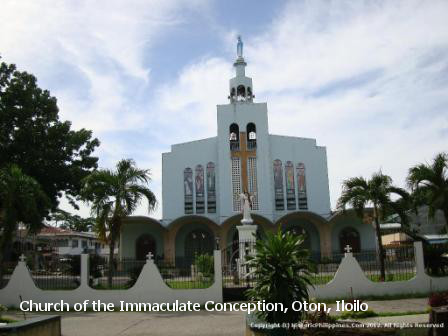
The Augustinian Friars first arrived in Oton as early as 1572 under Friar Martin Rada from Dumangas where he had established ‘the church’ in southern Panay having been sent there from the town of Pan-ay in Capiz in 1566, because of his success in evangelizing the population and his ability in the languages of the region. According to history the first Church built by Friar Rada (date unknown) was destroyed in 1614 when Oton was attacked by Dutch Privateers who razed the church in one of their raids.
The on-going history of the church in Oton is very unclear with the next reference to church construction, according to The Panublion, being in the mid 1800′s.
It was under the stewardship of Friar Demetrio Cobos, the parish priest from 1844 to 1854, that construction of the ‘new’ church was started. Construction, with interior decorations being made in 1882, was completed in 1883. It was officially blessed in 1891.
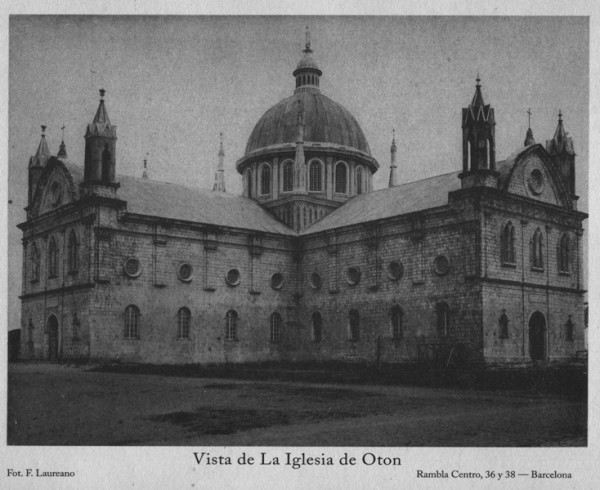
This was the largest church in the region at the time.
The original church was constructed in a blend of Greek and Gothic/Classical elements. It was built in the shape of a Greek cross in which all arms of the cross are of equal length. The massive and imposing altar was located at the centre of the cross.
Unfortunately this fantastically beautiful church was completely destroyed on January24, 1948 by the Lady CayCay Earthquake which had a magnitude of 8.1 on the Richter Scale.
There are only a very few reminders of that edifice on the grounds of the present church.
One is the portion of wall which now forms part of the grotto to Our Lady of Fatima on the northeast corner of the property. This is believed to have been part of one of the old church’s exterior walls.

Grotto of Our Lady of Fatima

Our Lady of Fatima

Parts of the remaining wall of the original church in the area of the Fatima Grotto which is overgrown with vegetation

more of the same overgrown wall of the original church, part of today’s Grotto
The other is a ‘stack’ of stone along the southwest edge of the property. This is likely coral and is possibly the surviving part of another wall of the old church

Limestone rocks believed to have been part of a wall of the old church found along the southwest property line on Zulueta St. in Oton

possibly a part of the original foundation of the old church?

more of that same possible foundation line?
If this is indeed the case, we have a clear indication of the monumental size of the church – it would have almost entirely covered what is today a whole city block. It would have been a truly impressive building.
Today, the modern sanctuary is strikingly beautiful. The crucifix behind the altar is that of Christ the King and is backlit in red, giving off a magnificent effect.

a view of the sanctuary during mass
The sanctuary itself if overlooked by huge stained glass windows depicting the 12 apostles, in groups of three at each end of the church. In fact six of these windows are in the Choir Loft facing the Sanctuary.

One of the stained glasses overlooking the Sanctuary

the second of the stained glasses overlooking the Sanctuary

The remaining stained glasses of the 6 other Apostles in the Choir Loft
At the front of the church is a full wall of stained glass which is quite stunning and which frames the sanctuary.

the stained glass ‘windows’ framing the sanctuary

The Blessed Virgin Mary

The Scared Heart of Jesus & the Immaculate Heart of Mary
At the rear of the church is a small shrine to Santo Niño, at which many parishioners can be seen offering prayers at all times of day or night.

El Senor Santo Nino
A very large crucifix, which is at least 8 feet tall, is displayed on the interior east wall of the church.

The life sized Crucifix
In addition, each of the church’s side windows, as seen below, features a different religious scene or theme also in stained glass. We’ve included four examples below.


Each of the entryways is topped with a stained glass window – this one is over the door on the northwest side of the main entrance and depicts Jesus, Mary and Joseph.


entryway on the northwest side of main entrance
The front of the church is graced by a statue of the Sacred Heart of Jesus who stands overlooking the town plaza and greeting parishioners as they arrive for masses and services.
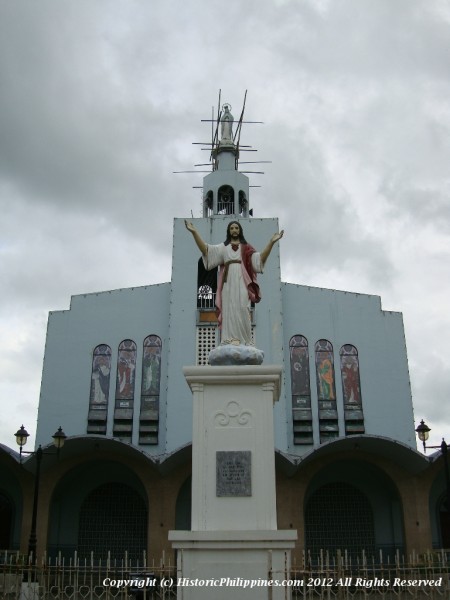
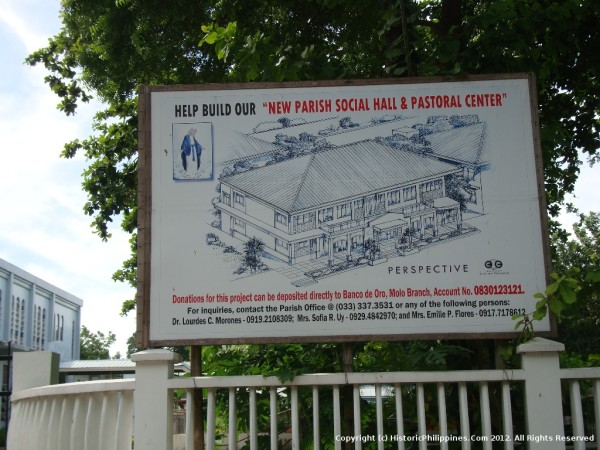
The parish in currently involved in major construction work in and around the church.
The spire/belfry is being repaired, a new parish activity centre and hall is being built, and the school (Immaculate Conception Parochial School) attached to the church is also being repaired and having renovations done.
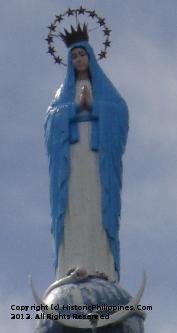
In fact the statue of the Blessed Virgin Mary atop the church’s central spire was being repaired when we visited. It was indicated to us during one of our visits, by Fr. Elmo Montaño, that it was a wooden sculpture of the Blessed Virgin and was being re-touched after almost 50 years in place. It had apparently been installed under the guidance of Fr. Ernesto Calvo in the early 1960s.

The construction of the new parish activity centre and hall is well underway as can be seen from the photos below which also show the original 1960s convento.
The new activity centre is located between the 1960s era convento and the adoration centre on the east side of the church.

The construction crew at ‘work’, greeting the Canuck!

Construction on new parish activity centre & hall (December 2011)

View of the construction site and existing convento
Next to the construction site is the parish Adoration Centre building.

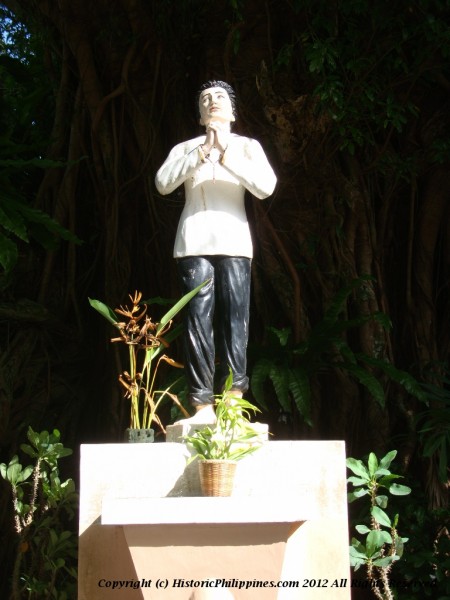
Just north of the Adoration Centre and next to the Our Lady of Fatima grotto is a meditation area dedicated to San Lorenzo Ruiz, the first native born Filipino Saint.
Lorenzo Ruiz was a layman, married, and had two sons and a daughter. Born in Binondo, Manila, about 1600′s, he was educated in the school of the Dominicans there. He left the Philippines in 1636 and landed in Japan shortly thereafter. On arrival in Japan he was arrested, imprisoned and unspeakably tortured refusing to renounce his faith.
He was hung by the feet and died a martyr of his faith in September 1637. He and his 16 companions were beatified by Pope John Paul II in Manila on February 18th, 1981 and subsequently canonized on October 18th, 1987.

Finally, we have come full circle, there is, next to the main entrance of the church, a plaque commemorating the blessing of the church on Christmas Day 1972. The plaque installed in 1988 is dedicated in memory of Monsignor Ernesto L. Calvo who was the first Filipino Parish Priest of Oton and the person who led the reconstruction of the Church . He was elevated to Monsignor on December 30th, 1967 and had served in Oton, as the Parish Priest from June 1960 to September 1980 when he was transferred to Dueñas.

 (1)Dislikes(0)