

Martin de Rada, OSA Born: Pamplona, Spain June 1533; Died: At Sea returning to Manila from the Borneo Expedition June 1578.

Friar Martin de Rada
1533 – 1578
Friar de Rada made his ‘profession’ in November 1554 at the University of Salamanca in Spain and became a full-fledged Augustinian Friar. Prior to that he had studied at the University of Paris and was known to be a gifted linguist and mathematician.
He volunteered to serve in New Spain (as Mexico was then known) in 1560. He quickly learned the local language – it is reported that he spoke the Otomi local language fluently after only 4 or 5 months in Mexico. He wrote prolifically in that language, which writings included instructional sermons and a book.
He was well regarded as an administrator by both his Mexican Augustinian colleagues and by his Superiors in Spain.
In 1564, as members of the Augustinian community were being selected to accompany Friar Andres de Urdaneta (the Superior and renowned navigator); de Rada’s Spanish Superior requested that he not participate in the expedition until the success of the Armada became known (supposedly, had Spain triumphed in their invasion of England, deRada may have been re-assigned there…).
On November 21, 1564, five ships and 500 soldiers, sailed from the port of Barra de Navidad, New Spain ( present day Jalisco State, Mexico).
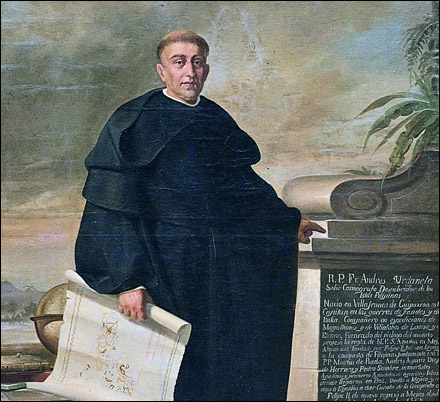
Friar Andres de Urdaneta
The problem was that when the order for him to remain in Mexico arrived from Spain, he had already sailed with Friar Urdaneta’s group of missionaries, as part of Legaspi’s expedition of discovery.
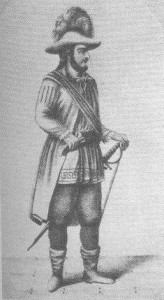
Miguel Lopez de Legaspi
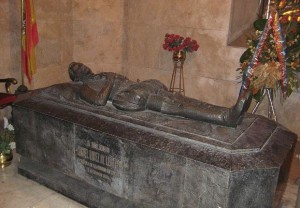
Legaspi’s Tomb in Manila
The 5 ships, similar to the one depicted in the painting below, arrived in the waters off present day Cebu in April 1565.
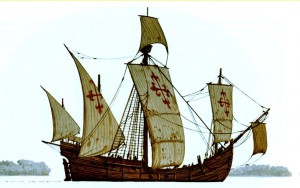
Manila Galleon
Friar de Rada and his companions were the first Christian missionaries to set foot on Panay Island. It is said that he was the first ‘priest’ to preach in the area of present day Pan-ay town, then called Bamban in late 1565.
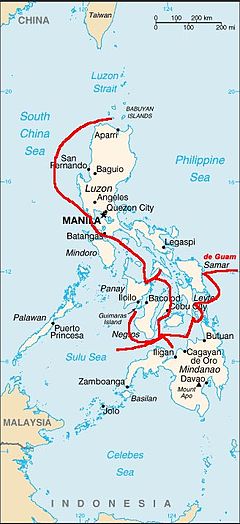
Legaspi’s Exploration Routes in Philippines
In early 1566 de Rada and his companion Friar Juan de Alva were sent south by Governor Legaspi as part of an exploratory group in search of a reliable food sources under Captain Luis de Haya. They arrived in the area of present day Dumangas. Where the Augustinians began to evangelize the natives and set up a chapel at Ermita, the ruin of which can be visited today. The expedition found what it was looking for – a reliable source of food for the garrison in Cebu and promptly returned north leaving Friar de Alva to minister to the locals in the Dumangas area.
Later that year, accompanied by Fray Francisco de Orteza, he returned to Panay, landing at Ogtong (present day Oton), where in 1572, he established the first parish in Western Visayas dedicated to Our Lady of the Immaculate Conception.
[In 1614, the Dutch attacked Oton destroying its industry of breeding horses. The history of church building is sketchy although Fr. Rada is reported as building a church of good quality, it was destroyed during the attack by the Dutch.]
Later that year, in May, he was named the first Augustinian Provincial Superior in the Philippines with motherhouse at the Oton Convento. At that time, there were four Augustinian missions in the colony: Oton, Cebu, Manila, and Tondo.
As an aside, it is important to note that while still in Cebu, he became interested in China and started to study the Chinese language. As usual he became quite proficient in the language and served as interpreter for a group of Chinese merchants who visited the colony.
As Superior, he eventually moved to Manila and became well known as a protector of the natives against Spanish abuses. He was particularly incensed by the enslavement of the natives by the Spaniards and by their continuous abuse of the population.
He sent many reports to the King in Spain and in one case, in late 1573 or early 1574 sent a Friar named Hettera to report directly to His Majesty. Friar Hettera brought back the Kings reply in the form of a Royal Cedula (a Royal Decree) dated November 1574.
In essence the King stated/ordered:
- That no Spaniard in the colony could own slaves,
- That the Augustinians were to correct the abuses and bad habits the Spaniards had vis a vis the native population,
- That the Augustinians were to build Monasteries throughout the Islands,
- That Spanish officials in the Colony participate in Limosna or the Giving of Alms,
- That the Missionaries build hospitals for the Spaniards and Natives alike,
- That the Augustinians were authorized to pursue their ‘dream’ of evangelizing China.
In mid-June of 1575, de Rada and Friar Jeronimo Marin were part of a delegation that visited China and returned to Manila in late October the same year. De Rada wrote a detailed report on his observations of the Chinese people and their way of life.
In 1578 the Governor of Manila asked him to accompany an expedition that was mounted to go to Borneo where there was a feud within the Sultan’s family. De Rada was to mediate and try to resolve the situation. Unfortunately his efforts failed and the expedition returned to Manila. On the return trip many of the crew fell sick and died, de Rada was one of the unfortunates. He died at age 45, at sea between June 8th and 15th just prior to arrival in Manila.
The influence of the Augustinians in the Philippines was truly inspiring and the work they accomplished during this period in the Philippines was quite significant. They founded and administered 130 towns, 187 churches and monasteries, 90 schools, 15 chaplaincies, 3 asylums of charity, 7 schools, 1 university and 272 parishes. Besides, they discovered various centres of medicinal water, built highways, roads, bridges, and published numerous books of history, grammar, languages, catechisms, works on botany, etc. Over the years between 1564 and 1898 about 3,150 Friars served in the Philippines and most of them originated from the Monestary at Valladolid in Spain.
For those who follow us on a regular basis, you will recall that we make an effort at each church we visit to find actual proof that it was built by the Augustinian Friars. We do that by trying to find the Augustinian Seal which is usually built into one of the facades of the church. On the Museo Oriental’s website we found the source of all the others:

Emblem of the Augustinian Order.
Church of the Royal College of
the Augustinian Fathers in Valladolid.
Work of the Brothers Maumejean,
Madrid 1937.
SPECIAL NOTE:
We wish to thank Blas Sierra de la Calle of the Museo Oriental, Real Colegio PP. Agustinos of Valladolid, Spain for his permission to use photos from the Museo Oriental’s art collection.
PLEASE VISIT THE MUSEUM’S WEBSITE AT

 (1)Dislikes(0)