


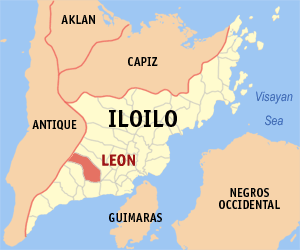
The driving distance from our jumping off point at the SM City parking lot in Iloilo to St Julian’s in Janiuay is approximately 27 kilometres. Which translates into a driving time of about 45 minutes to 1 hour.
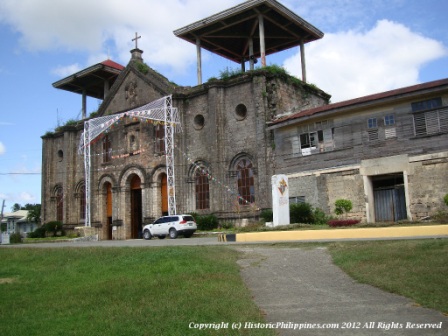
Church of St Catherine of Alexandria, Leon
This Church was built in 1869, we believe by the Augustinians since their trademark seal appears on the front of the church. With the first mass being said in 1873.
It is said that the church was one of the largest stone structures on PanayIsland when it was built. It Measured 300 feet long by 100 feet wide. The limestone used in the construction was quarried in the nearby Ayabang Mountains and transported to the site by sleds.
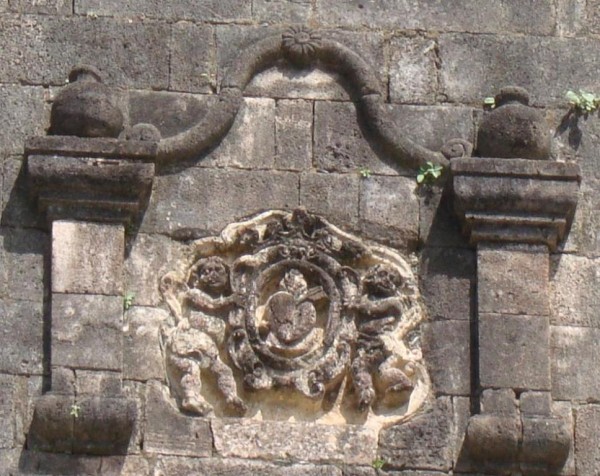
It is another Augustinian church, as evidence by the Seal above the main entrance. The Friar in charge of design and construction was Friar Manuel Arizmendi.
It is built in the Romanesque/Byzantine Style. This is an architectural style of Medieval Europe characterised by semi-circular arches. Romanesque architecture is known by its massive quality, its thick walls, round arches, sturdy piers, groin vaults, large towers and decorative arcading. In architecture, a pier is an upright support for a superstructure, such as an arch or bridge. Sections of wall between openings function as piers.
Romanesque buildings had the overall appearance of simplicity when compared with the Gothic buildings that were to follow. It should be noted that for any number of reasons the church was never completed and some areas of it are still, today in the 21st century, in ruins.
The main façade is quite plain having a niche with a stone statue of St. Catherine of Alexandria over the massive carved wooden doors set in huge stone arches.
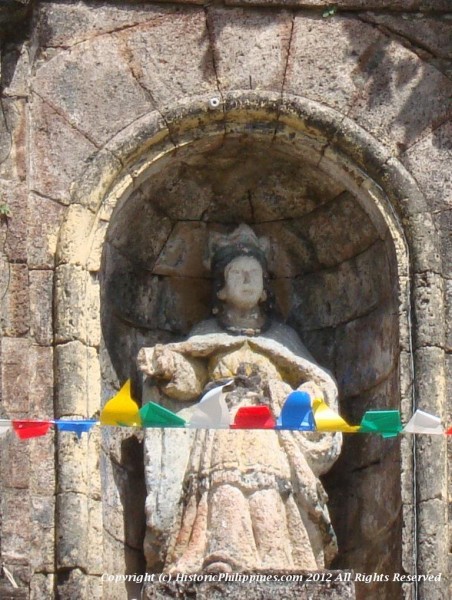
Statue of St Catherine in a niche above the main entrance
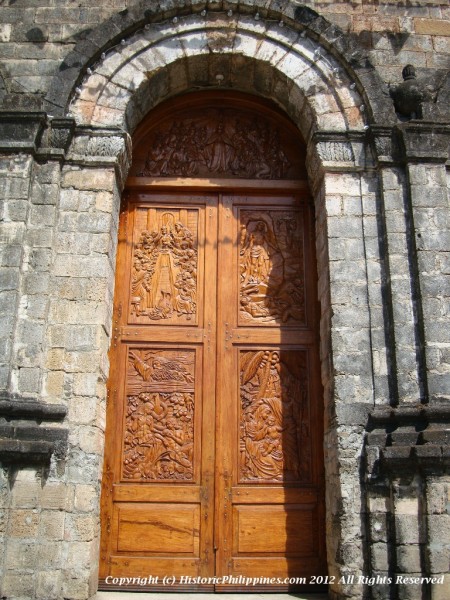
Intricately carved main doors
The interior of the church is quite awe inspiring in that it is one of the largest churches we have seen to date. However, its interior walls are still basically the original stone walls that were built in the 1860s. They have not been painted or plastered with the sole exception possibly being the area at the front of the church and around the sanctuary.
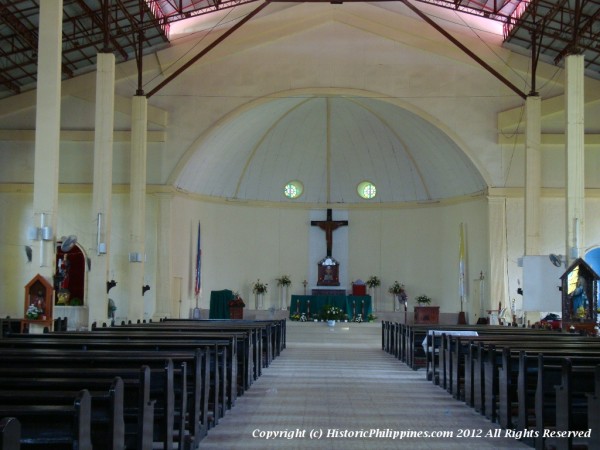
a view from the entrance way towards the Sanctuary
But when looking the other way (from the front of the church towards the main entrance) we see quite another viewpoint, there is no plastering and all there is, is the original stone work. It is remarkably beautiful.
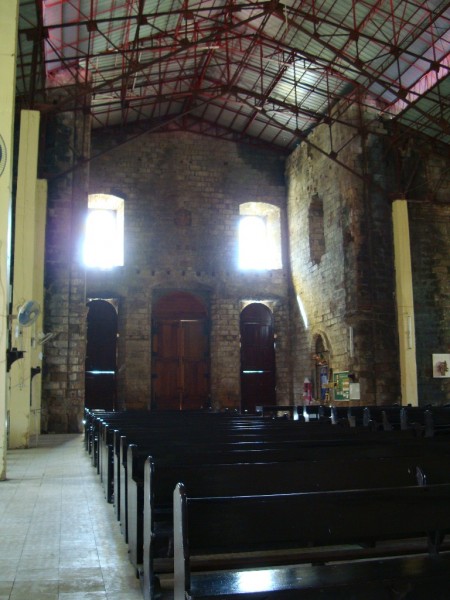
View towards the rear of the church
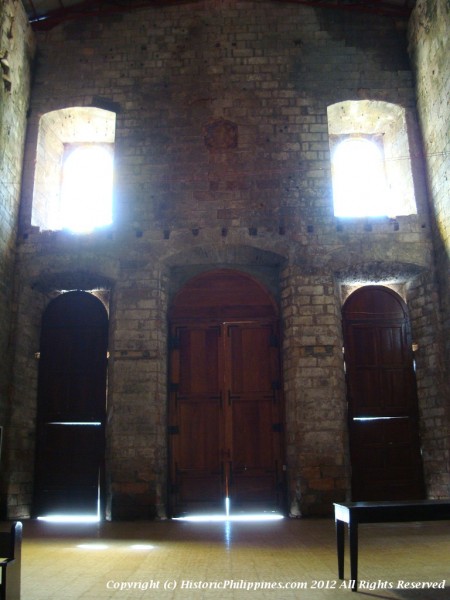
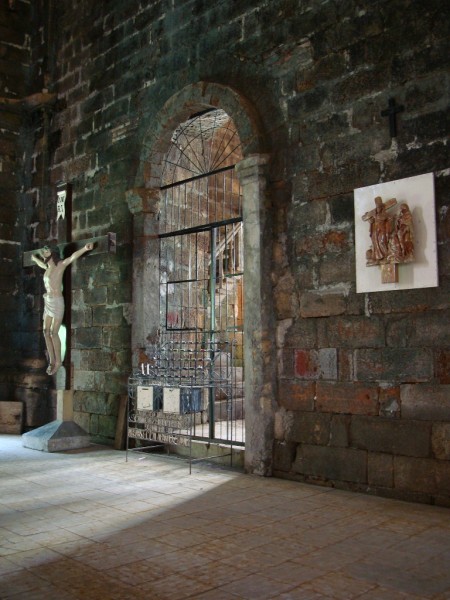
View of the entry to the Baptistery at the rear of the Church, to the left of the entrance lobby
In the church itself there are several interesting statues of Saints that have never been among the most popular. One is a small shrine to the Saint Father Annibale Maria Di Francia who had dedicated his life in the 1870s to the service of the poor and dispossessed as well as to the orphans in the town Avignon in France. St Annibale died in 1927 and his remains are in the church of the Rogazione Evangelica and are incorrupt in a sealed case under the main altar of that church.
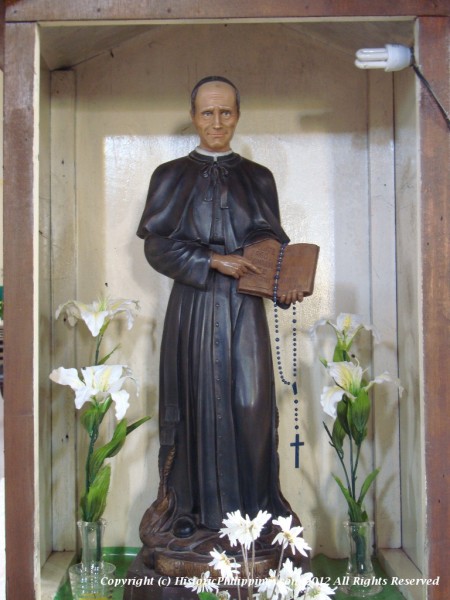
St Annibale Maria de Francia
Another shrine is to St. Catherine of Alexandria, herself, the patron Saint of the Parish.
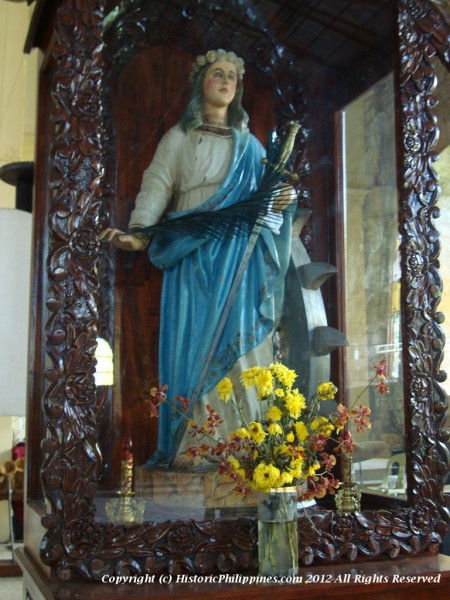
St Catherine of Alexandria
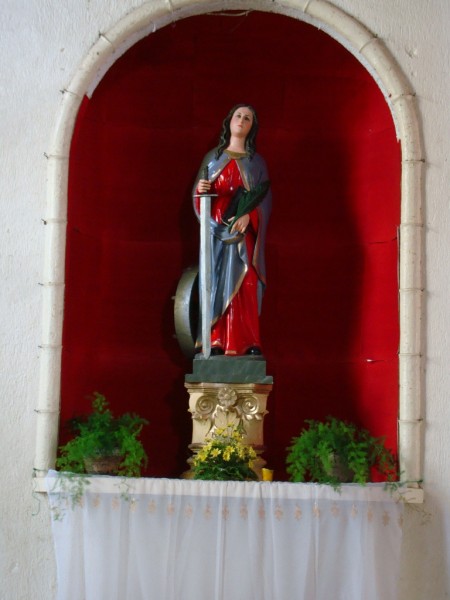
St Catherine of Alexandria
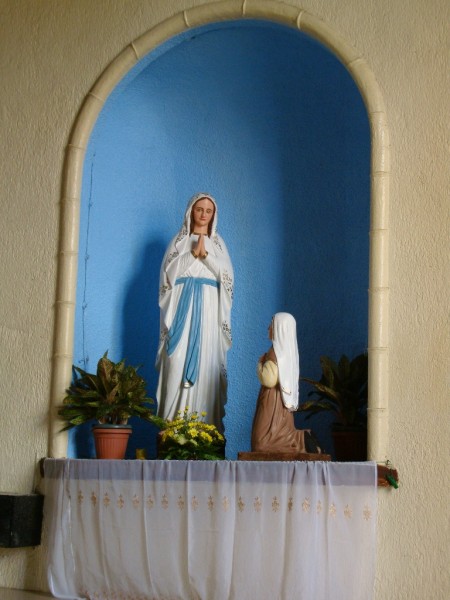
Our Lady of Fatima
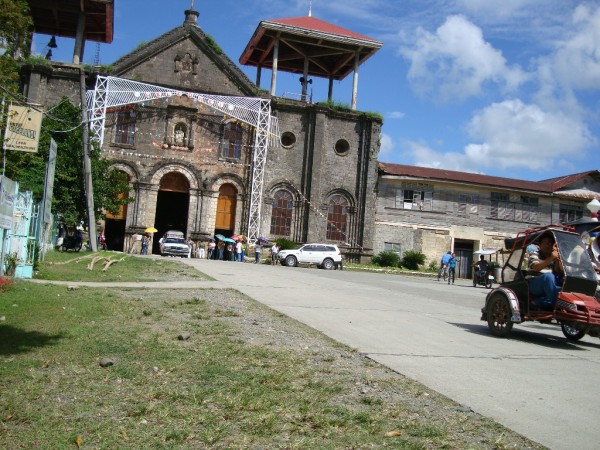
When we were able to view a part of the ‘convento’ from the inner courtyard we were quite surprised that it has been allowed to deteriorate to such an extent that we believe that it might be on the verge of perhaps being condemned.
The exterior stonework of the church requires extensive restoration work as can be seen from the photo of the convento above and the photos that follow.
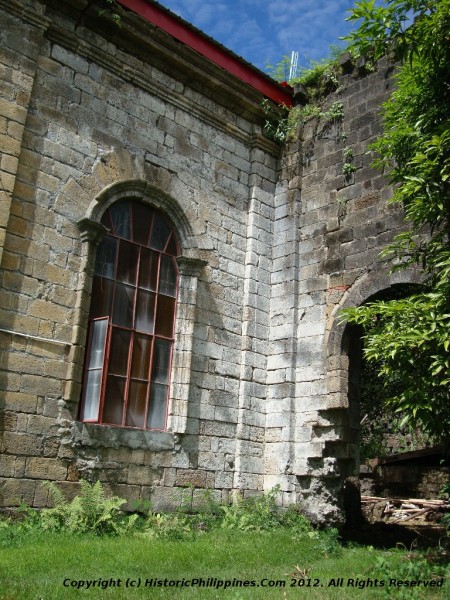
Stone work in need of major refurbishment
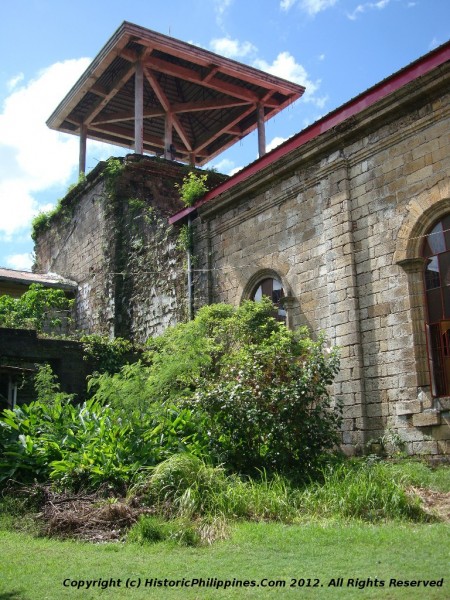
More stonework in need of refurbishing
In roaming around the property, we also came upon an area that was open to the elements and which apparently was used for some type of meetings. In the area we found what appears to the wall of a former part of the original church and leaning on that wall was a very interesting icon – which looked like it had been abandoned there. Although the area appears abandoned, it is in actuality used by various church related service clubs as their meeting area.
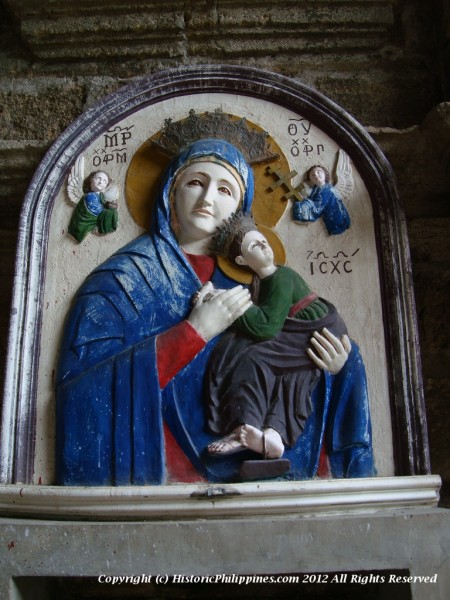
Our Lady of Perpetual Help
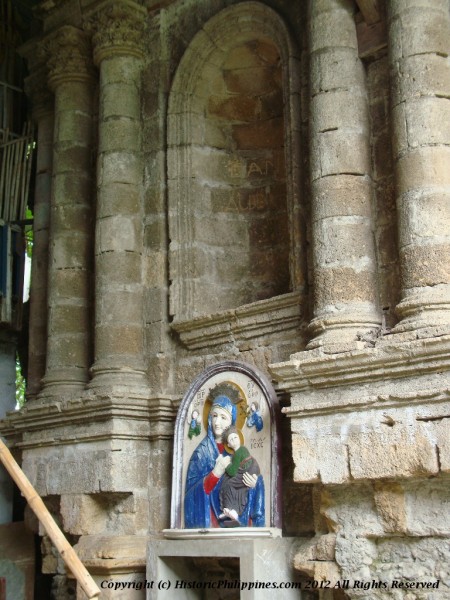
Icon of Our Lady of Perpetual Help and a section of abandoned wall of the ‘old’ church
This is quite possibly part of the area left ‘uncovered’ when the Americans removed the cruceros and roofing, outlined below.
In 1898, during the Spanish-American War when the Americans came to Leon they unroofed the cruceros and the main altar at the back of the existing church and used those materials to roof the school building being built on west side of the plaza.
The mountains aroundLeonwere a refuge for the guerillas in both the Revolution, the Spanish-American War. The Americans made the church their headquarters during the revolution.
During the Japanese occupation in World War II the church served as a prison camp for the natives as well as the Japanese area headquarters and garrison.
Before leaving we just had to get a photo of the present day ‘convento’, the parish hall and activities centre. They are all housed in this modern building.
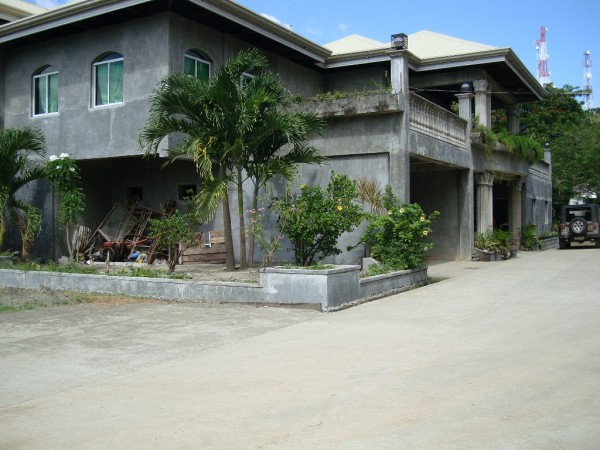
St Catherine of Alexandria
St. Catherine of Alexandria was the beautiful daughter of the 4th Century King and Queen of Alexandria, Eqypt. She was well educated in the arts, sciences and philosophy. She became a strong Christian in her teenage years, although having been raised in a pagan environment as a result of a vision she had of the Blessed Virgin and Jesus Christ in which the Blessed Virgin ‘gave’ Catherine to Jesus in a mystical marriage.
As a young adult she visited her contemporary, the Roman Emperor Maxentius to convince him to stop persecuting the Christian and worshipping idols. The Emperor arranged for his ‘pagan’ experts to debate Catherine so that they would refute her Christian arguments, Catherine won those debates and the Emperors experts all converted to Christianity. They were all executed by the furious Emperor who also had Catherine flogged and put into prison.
She was visited by hundreds while in prison including the wife of the Emperor who all converted – the Emperor was so infuriated that he had them all martyred for their faith. Maxentius seeing that he was loosing the battle of wits decided to propose marriage to Catherine, who declared herself to be the bride of Jesus to whom she had dedicated her virginity.
The by now enraged Maxentius had Catherine condemned to death on a spiked wheel of torture – when the time came for her to be put to death the wheel was miraculously destroyed apparently in answer to her prayers and so Maxentius had her beheaded.

This work is licensed under a Creative Commons Attribution-ShareAlike 3.0 Unported License.
 (0)Dislikes(0)







pwede po makuha po ang tel.. no po ng St. Catherine of Alexandria Parish
Ernesto the information we currently have is from the Archdiocese of Jaro webpages:
St. Catherine of Alexandria Parish
Address: Leon, 5026 Iloilo, Philippines
Phone: +63 33 331-0030
Parish Priest: Father Jesus Cabalum, VF
Parochial Vicar: Father Pope Ybañez
Resident Priest: Father Everardo Cansancio
Established: 1732
Feastday: November 25
Titular: St. Catherine of Alexandria
The information provided by the Archdiocese is notorious for being out of date...a little caution is therefore urged.