


The driving distance from our jumping off point at the SM City parking lot in Iloilo to the church in Igbaras is approximately 39 kilometres. Which translates into a driving time of about ¾ hour to 1 hour.

The Church of St John the Baptist in Igbaras is obviously a church that of more recent origin than any of the others we have seen so far.
The first church built in the area was in fact a Chapel built in 1763 of logs, bamboo and cogon grass. It was built on the banks of the river Tangyan, but because of persistent flooding in the area the chapel was moved to a location on the town site close to where the present public market is located. In 1765 a rudimentary stone church was built by Friar Juan Aguado.
But flooding was still a problem even at this new location and as the town grew it became apparent that a new and much larger church would be needed. In 1868, therefore, Friar Celestino Fernandez started the construction of a new church on the current site. It took ten years to build the church with forced labour once again as was the custom of the time. Every male member of a family was required to provide blocks of stone or tabrea from the nearby mountains, as well as ash, lime and whites of egg which were used as the ‘cement’ in the construction. Sacraments such as baptisms, marriages etc…were only performed by the priest if that family’s quota had been filled.
The belfry, one of the tallest in the region, used 6 different sizes of bells and when rung they could be heard in the farthest reaches of the town site.
In 1880, Friar Ignacio Marcos, continued the construction work with the building of the convento and the parochial school which were completed in 1910.
We found a painting of the original church painted directly on a wall of the current parish centre. The painting was created by: R. Esteves de Obrero in 2004.
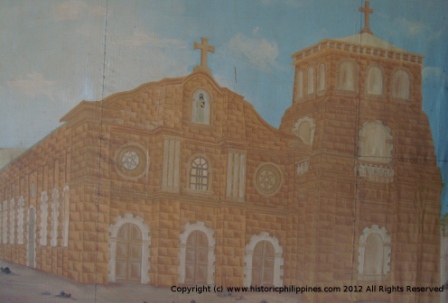
Pre World War 2 Painting of the Church
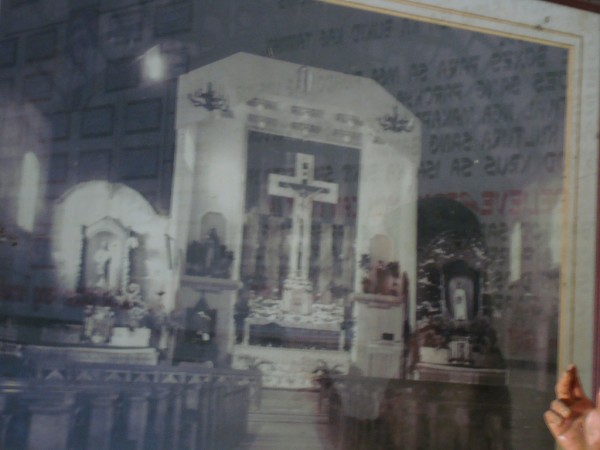
In addition, we saw an undated photographs of the original church.
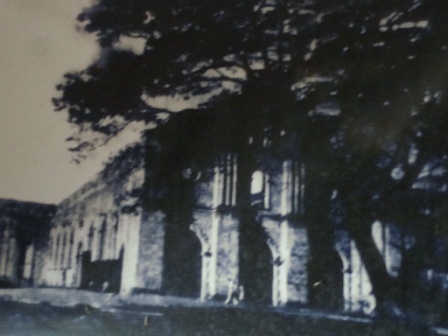
There was also a photograph of a painting by Ben Emmanuel in 1994 of the Pre-war and Pre-1948 Convento.
(Mr. Emmanuel contacted us in October 2013 to indicate that we had credited the painting wrongly as being the work of H Manuel. Mr Emmanuel is actually the artist. We apologize for the error and have now corrected it. Mr. Emmanuel lives in California and is 92 years of age. Thank you sir, for bringing this error to our attention. We appreciate the trouble you took to do so and again, we apologize to both you and your family for our error).
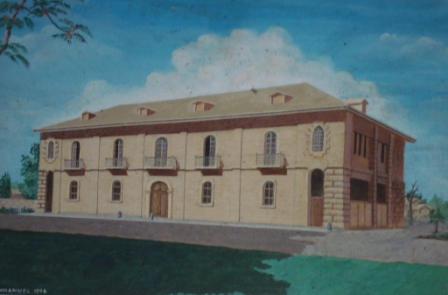
painting by Ben Emmanuel in 1994 of the Pre-war and Pre-1948 Convento
Unfortunately, the original church and convento were completely destroyed by the Lady CayCay earthquake of 1948.
There are, on the grounds, various hints of how large the original church might have been. At one end of the property we can see a shrine/grotto of Our Lady of Fatima – this area, apparently, was the sanctuary area of the old church. A few items of historical significance survived the Lady, for example: the bells from the belfry, the silver altar from the church itself and other miscellaneous items such as silver candle sticks. Many of surviving items were stolen from the church in the early 1970s and are still unaccounted for.
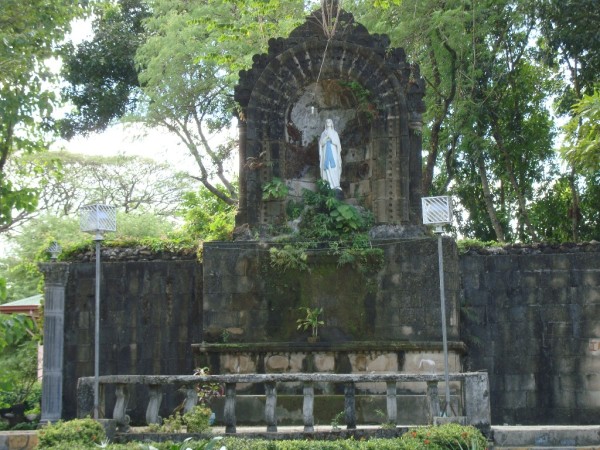
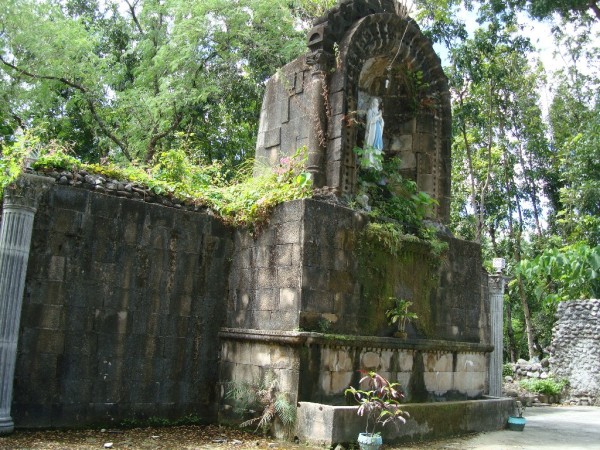
Adjacent to this grotto is part of one side wall of the original church which is still standing…
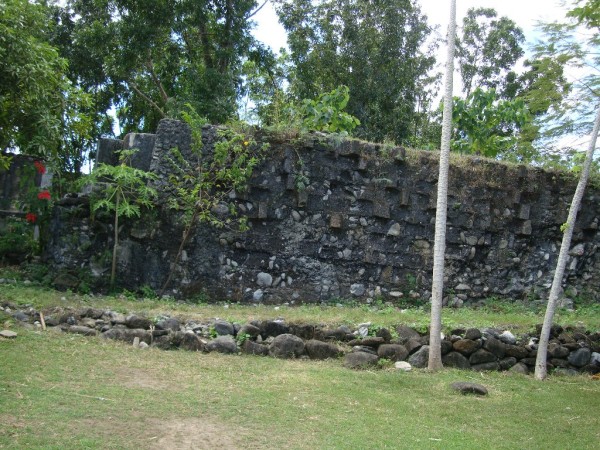
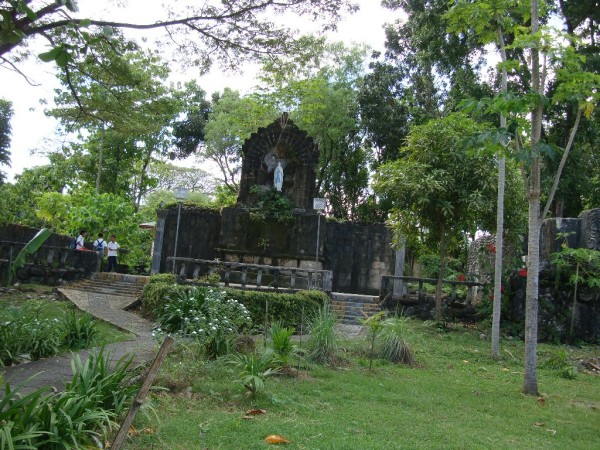
In another corner of the property of the Adoration Chapel, which also stands in an area that had been part of the old church. It is almost entirely built with materials salvaged from the ruins.
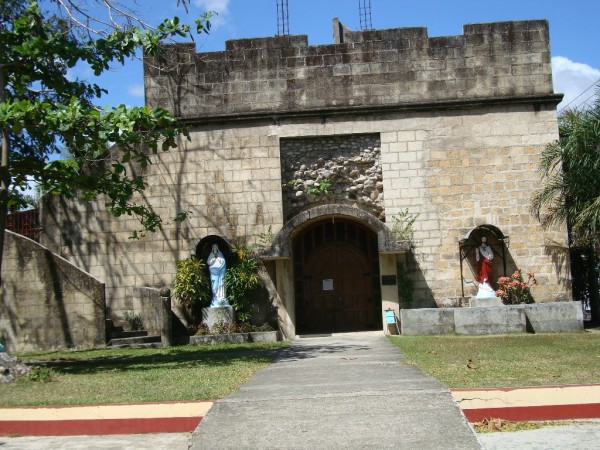
Following the monumental disaster of 1948 a simple church of bamboo and nipa was constructed at the back of the site surrounded by the ruins.
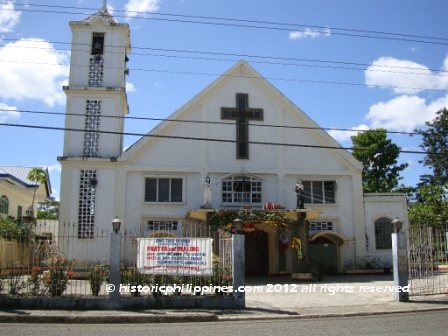
In 1950, the then parish priest Father Andres Jacob (of the Mill Hill Missionaries) started construction of the present day church using ‘modern’ building materials – concrete and hollow block.
This was followed in 1958, under the guidance of Father lorenzo Ober who built the Convento and in 1965 under the tutelege of Father Pedro Sedantes when the church companille was built and several repairs and renovations were carried out in several areas such as the renovations of the convento and repairs to the church itself…an on-going process for all such buildings.
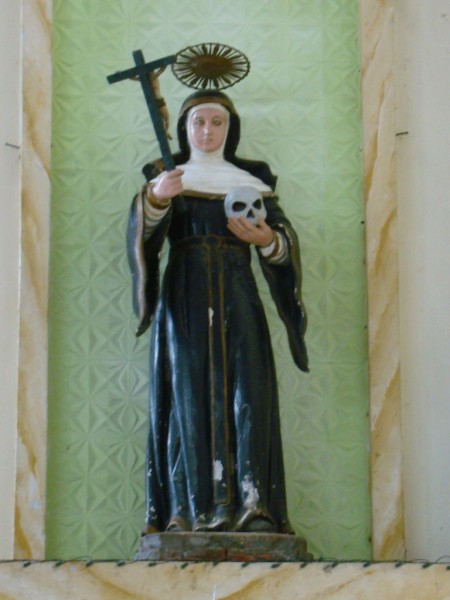
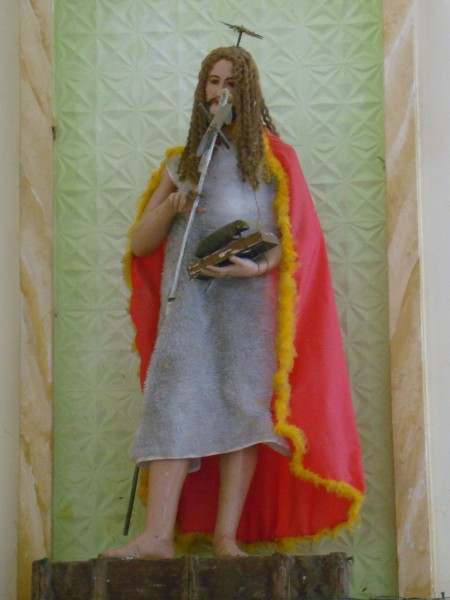
The church today, is modern and is well maintained. The main entrance is covered by a portico on which stand staues of St John the Baptist (the parish’s patron saint) as well as St Rita of Cascia.
The town actually celebrates two fiestas annually. One on June 24th the Feast Day of St John the Baptist and on May 22nd which is the Feast Day of St Rita of Cascia.
There is an interesting story behind the fact that Igbaras celebrates two fiestas within a month of each other.
Amrbosio Eilang Gotera in his The Igbarasnon, Volume 1 provides this explanation:
“Every May 22nd, St Rita of Cascia is honoured by Igbarasnons. They prepare food for their visitors who come to seek favours from the Patroness of Impossible Things. Every home in town is ready to receive both expected and unexpeted guests even a few days before the fiesta. They consider them the visitors of St Rita. They unselfishly and tirelessly offer them food for the whole day. Usually visitors from other towns come for fresh serguelas (philippines plums) which are in season during the month of May.
All Igbarasnons cooperate to make the fiesta a successful and memorable occasion. In the church, a novena to St Rita starts on May 14th and culminates with high mass and a procession with the statue of the saint around the town plaza. After mass, the faithful participate in a unique ceremony called ‘palapak’, in which the priest holding a statue of the saint, touches the head of each faithuful as he invokes her intercession…
…The reason for having the second fiesta goes back to 1900, when there was a cholera epidemic in the town and people were pleading for the help and intercession of the saints. Many prayed to St. Rita. Rosa, one of the devotees was cured. As in the life of St Rita , Rose was suffering from the abuse of her husband who was a gambler and a dru nk. Despite her husband’s cruelty, she remained faithful to him, forgave him and prayed for him. One day while she was weaving patadyong she saw the statuette of St Rita walk across the loom. She revealed this to the parish priest, Father Felix Gedican who asked her to prove it through a miracle. Rose had some of the cholera victims kiss the image of the saint and many of them were cured. Because of this miracle, the first fiesta of St Rita was celebrated on May 22nd, 1901.
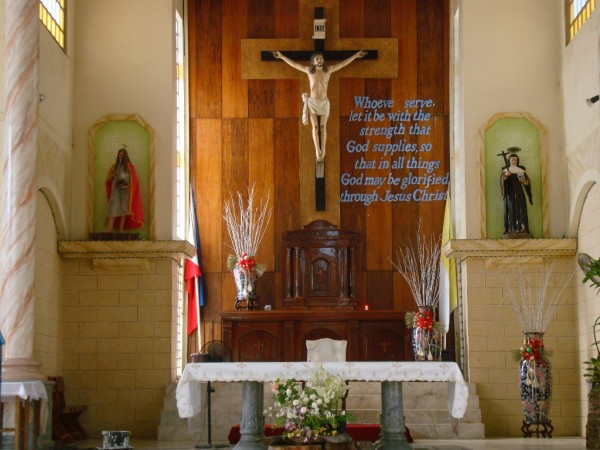
On entering the church we find a bight and airy nave leading upto a strikingly beautiful sanctuary.
And here is another photo we were shown which shows the Sanctuary area of the original church.
The main altar carved from local wood is flanked by statues of St Rita and St John The Baptist.
The ceiling is barrel shaped and is light by large plain stained glass windows the whole length of the church.
The ground level side walls are covered with gratings and are effectively open to the elements – a very airy feeling is what you get when sitting in this lovely church just contemplating life or the world!
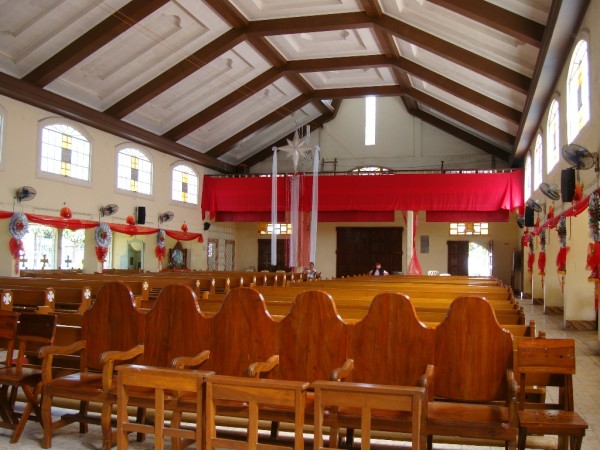
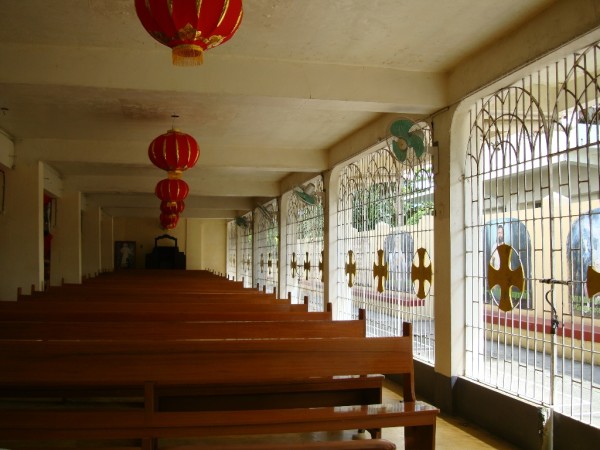
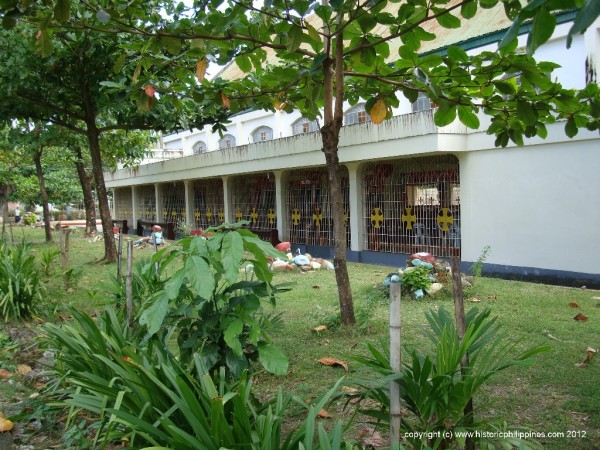
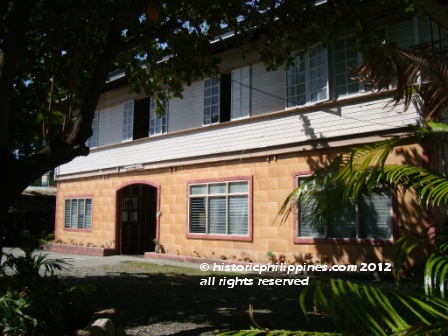
When we leave the church through the main entrance and head towards the Convento and the Parish Centre we encounter a fountain in the garden of the yard facing the convento.
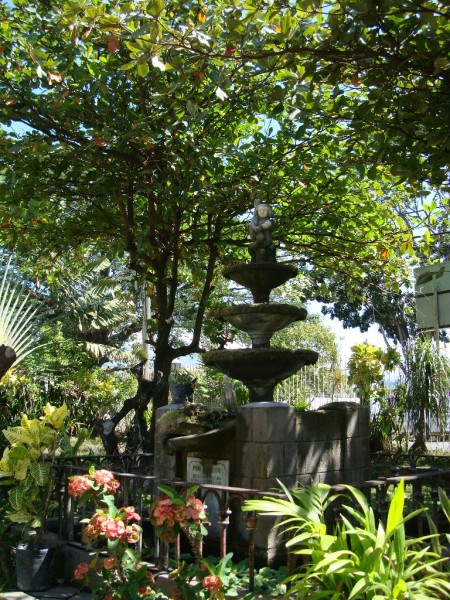
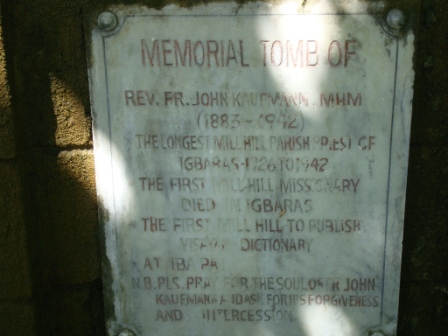
This fountain was very interesting and we investigated a little more and spotted the above plaque embedded in it.
It’s a memorial in honour of Father John Kaufman if the Mill Hill Missionaries, who was the parish priest of St. John’s between 1926 and 1942 when he died.
Father Kaufman is very noteworthy because he wrote and published in the early 1930’s a Visayan/Hilagaynon (Ilonggo) English dictionary which is still considered today as being one of the leading such publications. In addition, Fr Kaufman laso translated the New Testament into Hilagaynon and wrote a textbook on Hilagaynon Grammar – both his major works the dictionnary and the grammar text are now in the public domain and can be easily referrenced on the internet.
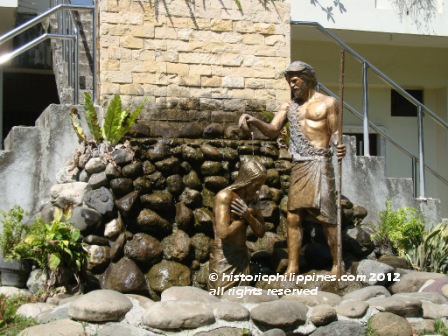
If we simply do a 180º turn and face the convento we see before a modern home with another fountain in front. This one is a fountain of St. John the Baptist, presumably baptising Jesus.
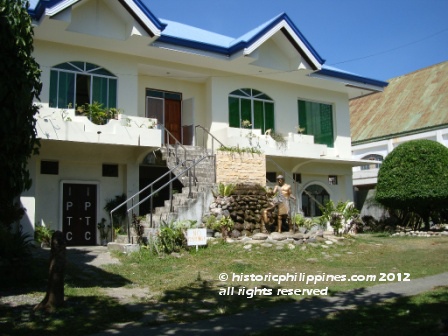
Facing the Convento, to our right is the church with its five story high bello tower containing those 6 original bells.
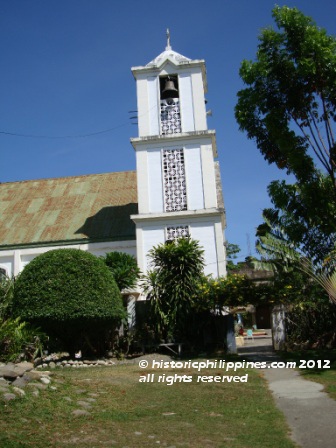
And to the left is the Parish Centre.

This work is licensed under a Creative Commons Attribution-ShareAlike 3.0 Unported License.
With special thanks to:
* Fr Melvin Daquilanea, Parish Priest, Parish of St John the Baptist, Igbaras
* Cherel Gravera, Secretary, Parish of St John the Baptist, Igbaras
Principal Referrence:
Amrbosio Eilang Gotera, The Igbarasnon, Volume 1, 1970
 (0)Dislikes(0)







I noticed that you printed a painting of the convento and credited it to "H. Manuel." I am the artist who painted it and donated the original to the convento in Igbaras. t wasI signed "Ben Emmanuel 1994." You can verify this through my niece Michaela Esmeralda who lives in Igbaras.
Ben Emmanuel, aged 92 and residing in California, USA
October 2013
Mr. Emmanuel, we apologize for the error and have now corrected it. Thank you sir, for taking the time to bring it to our attention – we appreciate the trouble you took in doing so and once again apologize to both you and your family for our error. Best Regards!
Mr. Fergus, thank you so much for rectifying the minor error. I did not expect to see any results so quickly. Your webpage is a beautiful tribute to my hometown of Igbaras and I was very happy to see the improvements. This website came to my daughter's attention in the process of researching materials to supplement a book I am writing. This book is based on my memories of World War II which I survived in Igbaras when I was in my early 20's. Included is an article on the history of the convento and the church. I was in Igbaras when the convento and old church were burned by the guerrillas so these buildings would not be used by the Japanese forces. As a young architect in 1950 I participated in the initial development of the new church. While my memory still serves me, I want to share what I know with the new generation of Igbarasnons. Again thank you for creating and maintaining this webpage.
Mr. Emmanuel, thank you for the beautiful comments. We work very hard to ensure we have an excellent and interesting 'product' for our readers and it is very gratifying to see that so many people enjoy our work.
You mentioned that you are writing a book on your WW II experiences. Now, there is something we would be very interested in seeing and perhaps including a chapter or two on your adventures on our new sister website at: www.oldphilippines.com, once the book is ready to go. Your story, from just the little snippets, I have read in your two messages indicate to me that you're story just might be something that our readers would enjoy enormously. Thanks for your service to your community in Igbaras and to the Philippines in those trying times.
God Bless You!
I will be very happy to share my book with you. My daughter is editing it for typographical errors and my grandson in Guam will finalize and print it. It is gratifying to find a kindred soul, someone interested in the authentic history of my beloved hometown, Igbaras. Please email me to let me know where I can mail you a copy.
I understand the need to get as many eyes on a document as possible. Everytime I post, no matter how many times I have re-read the material, I usually have to go back and make several corrections. I will send you a separate e-mail with my personal e-mail address.
Thank you for providing us this opportunity.
I was not baptized in Saint John the Baptist Parish nevertheless this church gave me a lot of memory. This is where I found solace and acceptance. I was once a new girl in school and cannot understand their dialect. My teacher brought me to this church and ask me to join the Church choir. Not knowing that, that was the beginning of my life serving God.
Saint John the Baptist is truly special. It's structure, history and the people whose unselfishly serving God in so many ways. I do hope someday when the right man comes, I could also spend my special day in Saint John the Baptist!
Robelyn: I'm really pleased our site brought back some memories from an earlier time for you and I'm very happy you took the time to visit with us. Thank you for your kind comments.
God Bless!