
The Little Blue Church pictured on our Christmas card this year has an interesting story behind it.

It is located just outside Prescott, Ontario in an area in which I lived for about 12 years, quite sometime ago. In an article written for the Rideau Township Historical Society website (www.rideautownshiphistory.org) by Lucy Martin, with pictures by Lucy Martin and Sandy Wilson this tiny historical old church is described as:
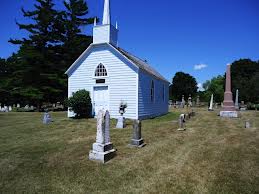
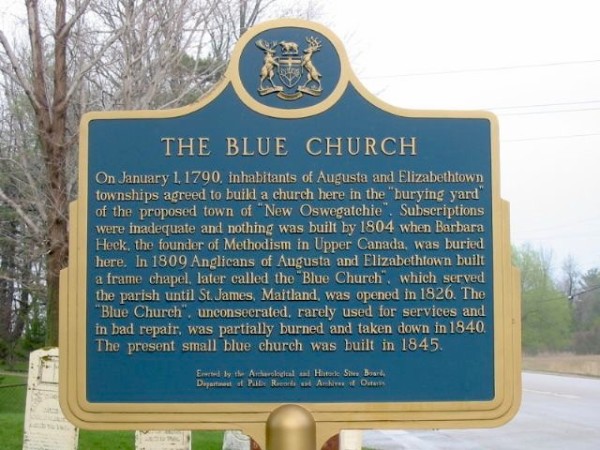
“The Little Blue Church”. The original church on the site was used from 1809-1826. It was destroyed by fire in 1840. The church seen there today was built in 1845. Though not in active use, the building is under the trusteeship of St. John’s Anglican Church in Prescott. The surrounding cemetery is one of the most historic in the area.
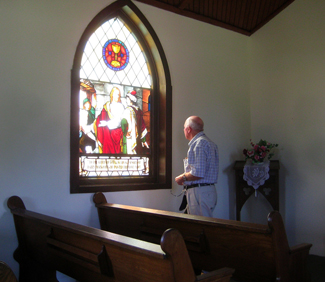
A stained glass window in the Little Blue Church.
One of the first buried there was Barbara Heck. Born in Ireland, Heck is credited with establishing the first Methodist congregations in North America – one in New York circa 1766 and another in Upper Canada, as a Loyalist refugee. Part of Heck’s memorial tombstone reads “In memory of one who laid foundations others have built upon”.
The cemetery is graced with lovely old trees and enjoys a fine view of the St. Lawrence River. It is still in active use. Our group enjoyed the church (inside and out) and strolling the attractive grounds looking at the grave markers.
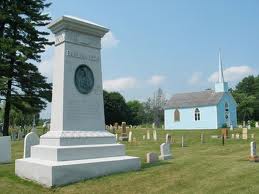
Barbara Heck’s grave at Blue Church, Prescott, Ontario
Lastly, we swung past the Battle of the Windmill site. The tall stone windmill is quite striking.

The “Battle of the Windmill” site with a ship passing down river on the St. Lawrence Seaway.
The site’s significance is described as follows on the Ontario Historic plaque: “After the 1837 Rebellions many rebels fled to the United States where a few joined American sympathizers in a new attempt to overthrow British rule in Canada.
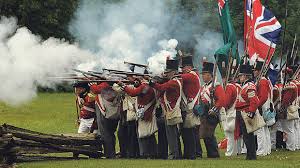
The British defending “Canada” against invasion from the United States
On 12 November 1838 they landed 190 men here and seized this windmill and nearby buildings. The local people remained loyal, reporting to their militia units; in a few days 2,000 militia and regulars, supported by naval vessels, besieged the mill. Although British guns did little damage to the mill, the insurgents, seeing no escape, surrendered on the 16th. Eleven were later executed and 60 exiled to Australia.”
 (0)Dislikes(0)