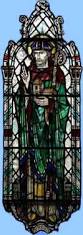

I don’t know about you, but I have always wondered if there was in fact a St Fergus. Oh, if you have a name like Peter, Marc, Michael or Mary, Jennifer and Lucy then there is usually no doubt that there is in fact a Saint after whom you are named. But when you have a, I’ll say it, a weird name, like Fergus, Algernon or even Gwynneth then you wonder.
I decided this week to research my Saint – Saint Fergus and this is what I discovered.
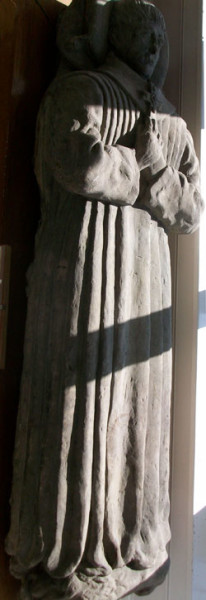
An effigy of Saint Fergus,
carved in the 15th Century.
Saint Fergus (also Fergustian) (died c. 730 AD) was a bishop who worked in Scotland as a missionary. Saint Fergus’ feast day is the 27th of November.
Ten saints of this name are mentioned in the martyrology of Donegal in Ireland.
No one knows for certain when Fergus was born or where. He was a contemporary of St. Drostan and St. Donevaldus. The name is of Pictish origin and he is recorded as Fergus, a Pictish Bishop, so it is generally considered was from the north east of what is now called Scotland. In the Aberdeen breviary he is called Fergustian and “he occupied himself in converting the barbarous people.” He is thought to have trained in Ireland or the south of Scotland, or possibly both.
Known in the Irish martyrologies as St. Fergus Cruithneach, or the Pict, the Breviary of Aberdeen states that he had been a bishop for many years in Ireland when he went on a mission to Alba with some chosen priests and other clerics. He settled first near Strageath, in Upper Strathearn, in Upper Perth in Scotland and erected three churches in that district. The churches of Strageath, Blackford, and Dolpatrick are found there dedicated to St. Patrick. He next evangelized Caithness and established there the churches of Wick and Halkirk.
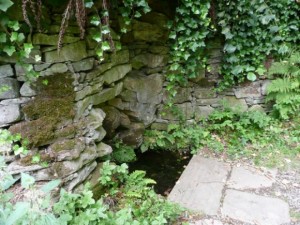
St Fergus Well, Glamis
© Copyright 2014, SCHR Ltd. All rights reserved
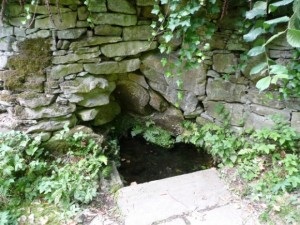
St Fergus Well, Glamis
© Copyright 2014, SCHR Ltd. All rights reserved
This natural spring is situated in a small river valley below the current Glamis Parish Church, and is reached by a steep path with steps. The site was said to have been where St Fergus conducted open air religious services in the 8th century before the first church of Glamis was built. The spring is known as a well, and has been built up with stone walls and slabs to trap the water for use. Behind the spring or well is a steep, wooded bank with rock outcrops. The river bank is just to the east and presumably the well area must flood from time to time when the river overflows.
The church Fergus built at Glamis would have been in the Celtic “mud and wattle” style, not far from the present kirk. Around 710 A.D., St. Fergus established a church near the site of the present building.
That first church would have been of typical, Celtic style, mud and wattle construction. “Environmentally friendly” long before the term was probably thought of.
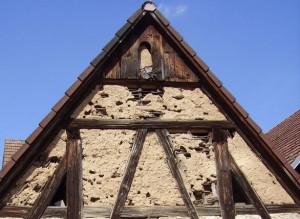
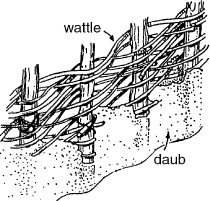
Wattle and daub is a building material used for making walls, in which a woven lattice of wooden strips called wattle is daubed with a sticky material usually made of some combination
A more sturdy structure made from stone was dedicated in 1242 and replaced about 1790. Since then, the church interior was “remodelled” and renovated in 1934 with the Chancel built then and the Pulpit moved from the south wall to its present position.
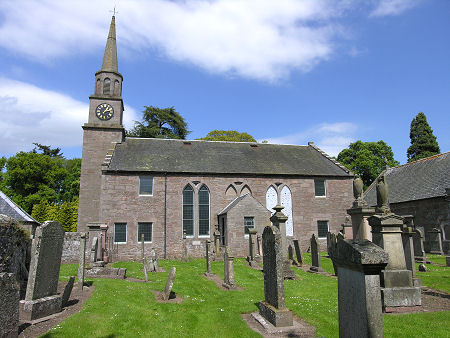
The cemetery has a number of interesting grave stones. The oldest has the date 1607 carved on it. Also, “Bonnie Dundee’s” rent collector or factor is buried here.
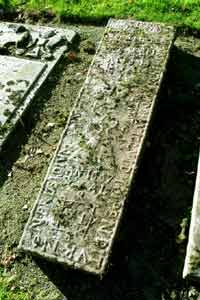
The oldest known grave stone in the cemetery of St. Fergus Kirk, Glamis has the date 1607.
A recumbent (lying down) stone which is quite worn, but, the markings are still visible in a good light.
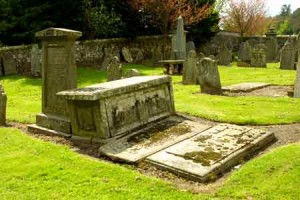 The 19th century botanist Thomas Drummond once lived with his wife and family in Glamis village. He was born in Inverarity, baptised and married in Inverarity Kirk not far from here.
Another past resident of Glamis was Margaret Bridie, reputed to have been the creator of the famous Forfar Bridie.
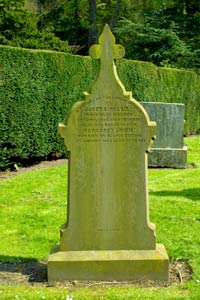
Margaret Bridie was reputed to be the “inventor” or creator of the culinary masterpiece known in Scotland as the Forfar Bridie.
She baked her “bridie’s” in Glamis village and took them to markets in Forfar which is about 6 miles away.
The Strathmore Aisle is the oldest part of the present church. The wife of the first Lord Glamis ordered its construction in 1459 for her late husband. When she died, she was buried alongside her husband. Strictly speaking, the Aisle is a “mortuary chapel” and stood apart from the church.
In 1971, the Reverend Dr. Henderson and congregation restored the Strathmore Aisle after it had been derelict for quite some time.
The Aisle has a “barrel-vaulted” roof with “badges” of the lion of Glamis and the impaled (standing) lion of Ogilvy seen at several points in the chapel.
On the east wall is the “Sacrament House”. Consecrated elements were placed and kept here by the priest though it is not the probable original position.
Around the stonework of the door, you will find markings made by stonemasons.

In 1971, the Reverend Dr. Henderson and congregation restored the Strathmore Aisle after it had been derelict for quite some time.
It was not connected to the present church until then. Mary, Dowager Countess of Strathmore, commissioned the stained glass window in memory of her late husband, Fergus, 17th Earl of Strathmore and the marriage of their daughter, Lady Diana Bowes Lyon.