

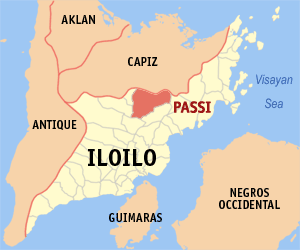

The town of Passi was established in 1584, and it is now Iloilo’s sugar and pineapple capital. Two of the province’s largest pineapple and sugar plantations as well as sugar refining plants are located here.
The present Church of St. William was built by Friar Apolinario Villaneuva, the town’s then parish priest between 1821 and 1837.
This is considered a militaristic church in that it was planned as a ‘fortress church’ and the proof of this can be seen in the massive buttresses which support the front and back walls of the church. The church was built to replace churches that had been destroyed by an earthquake in 1612 and subsequent churches that had been destroyed by fires.
The photo below shows the buttresses on the east side of the St William church in the ‘Garden of the Saints’.

In 1856 Friar Pedro Ceberio restored St William Church after it had fallen into disrepair and what we see today is the result of his work.
As is usual with churches of this vintage we can immediately discern that it was built, once again, by the Augustinians since their seal appears in the archway over one of the side entrances. It is said that the historical record is vague on the topic of entrances that indicates that historians are not certain as to where the actual main entrance was placed by the original builders. It appears that it may well have been this doorway on the southeast corner of the church at the entrance of the ‘Garden of Saints’.


All was well with the church through the Revolution and the Philippines American War but in 1932 the roof was blown away by a typhoon.
St William Church is surrounded by a ‘Garden of the Saints’ which contains 25 to 30 statues of Saints that have been placed in the garden by parishioners over the years. Some examples of the Saintly Statues are shown below.
[LEFT CLICK ON ANY PHOTO TO VIEW IN LARGER FORMAT]


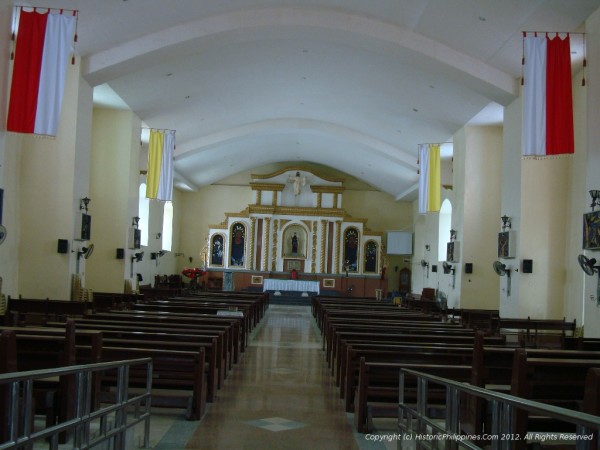
When one enters St William Church you are struck by how simple and bright it is as shown in the photos below looking towards the sanctuary at the front of the church or towards the rear of the church. The effect is due to the brilliance of the pure white marble floor blending in with the pure white ceiling and walls…

Every one of the side windows, twelve in all, is filled with stained glass renderings of each of the twelve apostles…examples are show below.
[LEFT CLICK ON ANY PHOTO TO VIEW IN LARGER FORMAT]


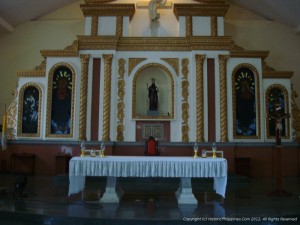
Perhaps the most striking feature of the entire church is the sanctuary, which when is light up is both dramatically breathtaking and simply beautiful, note the before and after pictures below…

Church of St William the Hermit, Passi City
St. William the Hermit, who was never personally associated with the Augustinians, and who died, in fact, 100 years before the Grand Union, was born in France.
He became a penitent pilgrim to many shrines of Christianity, and eventually became a hermit in the region of Tuscany, in a place called Malavalle (Grosseto), where he spent the remainder of his life in prayer, silence, fasting and penance until his death in 1157.
He did not found a religious community, nor did he write a Rule. But in the last months of his life a disciple who cared for him, wrote “The Rule of Saint William,” after the saint’s death.
William’s burial site was soon being visited by many pilgrims, some of whom remained in Malavalle to imitate William’s hermitical and penitential life and considered William their holy patron. Pope Innocent III confirmed his cult in 1202. With his canonization, devotion to William continued to spread as did the number of disciples who founded new houses in various places throughout central and northern Italy, as well as in what are now Belgium, Germany, Bohemia and Hungary.
In 1244 they became the Order of Saint William. In 1256 this Order was called by the Holy See to become part of the expanding Order of Saint Augustine.

This work is licensed under a Creative Commons Attribution-ShareAlike 3.0 Unported License.