

Passage into the Pacific Ocean; the journey continues.
You will recall that when we left Magellan and his party of explorers, they were dealing with a mutiny.

Mutiny at Puerto San Julian (see Part 1 of the Magellan Story)
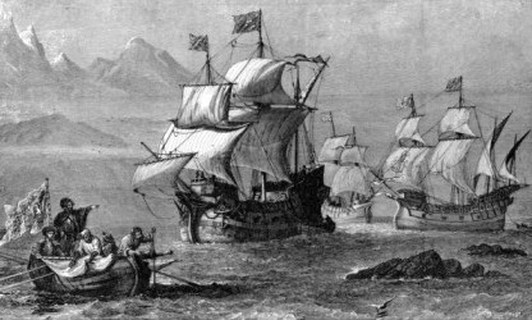
Mutiny at Puerto San Julian (see Part 1 of the Magellan Story)
Magellan with got the help of Duarte Barbosa which proved crucial in facing down the mutiny at Puerto San Julian. Magellan subsequently appointed Barbosa as Captain of the Victoria.

The Replica of the Victory at Puerto San Julian
zgellan sent the Santiago was sent down the coast on a scouting mission and was that ship was wrecked in sudden storm. The full crew survived and made it safely to shore.

The Santiago was lost during a sudden storm
Two of Santiago’s crew returned to Port San Julian cross country to inform Magellan of the disaster and to get help for their fellow survivors. Following the rescue, Magellan decided to wait for a few weeks before pressing on.

At 52° south latitude on October 21, the fleet reached Cape Virgenes and decided that they had found the passage because the waters were briny and deep inland. Four of the ships began an arduous trip through the 372 mile (600 kilometer) long passage which Magellan had named the: ‘Estrecho de Todos los Santos’ (All Saints Channel) because the fleet travelled through the straits on November 1 which is All Saints Day.


Magellan at first assigned Concepcion and San Antonio to move forward and explore the straight. San Antonio, commanded by Gomez deserted and returned to Spain, leaving on November 20. On November 28, the 3 remaining ships entered the South Pacific. Magellan named it so Mar Pacifico because of its apparent stillness. He and the crew were the first Europeans to reach Tierra del Fuego just east of the passage’s entrance.

The Victoria
 Heading northwest, the crews reached the Equator on February 13, 1521. On March 6, they reached the Marianas and Guam. Pigafetta described the ‘lanteen sails’ used by the inhabitants of Guam(hence the name Island of Sails) he also writes the inhabitants “entered the ships and stole whatever they could lay their hands on” including the “small boat that was fastened to the poop of the flagship. These people are poor, but ingenious and very thievish, on account of which we called those three islands, the Islands of Ladroni.”


On March 17, 1521 Magellan reached the Island of Homonhon in the Philippines with 150 of his crew still available. Members of the expedition were the first Europeans to reach the Philippines archipelago.


Several days later, once the friendship had been confirmed between Magellan and Koluambu they concluded a blood pact; a Kasi Kasi on March 29, 1521, which was Good Friday. In thanksgiving, Magellan has a mass said by Friar Pedro de Valderama on a promontory looking out to sea on March 31, 1521 which was Easter Sunday. This was the First Mass to be said in the Philippines (you will remember that the same Friar Pedro also has the distinction of having said the First Mass in Argentina at Puerto San Julian, earlier in the Voyage).

Friar Pedro de Valderama saying the first mass in Philippines, March 31, 1521

Enrique of Malacca
Rajah Kolambu of Limasawa, guided Magellan’s fleet to Cebu on April 7 since he was a close ally of the Datu of Cebu had been endentured by Magellan in 1511 after the conquest of the Moluccas and had accompanied him throughout his subsequent later adventures.
Rajah Humabon of Cebu was friendly with Magellan and the Spaniards, both he and his queen Juana were baptised as chirstians and were given the image of the Santo Nino along with a cross (today’s Magellan’s Cross) to symbolize the Christianization of the Islands.

Prior to their Baptism Raja Humabon & Queen Juana

The Baptism of Rajah Humabon & Queen Juana

Rajah Humabon of Cebu

Magellan presents Queen Juana with the Santo Nino


Queen Juana of Cebu with the Santo Nino

Later, the Rajah and his ally Datu Zula convinced Magellan to kill their mutual enemy the Datu Lapu-Lapu of Mactan, Cebu. Magellan wanted to convert Lapu-Lapu to christianity as he had Humabon and the others. Lapu-Lapu however rejected that plan.

Lapu Lapu & Magellan

Lapu Lapu of Mactan
On the monring of April 27, 1521 Magellan sailed to Mactan with a small attack force. During the resultant battle against Lapu-Lapu’s forces. Magellan was struck by a bamboo spear. He was later surrounded by the enemy and ‘finished off’ with various other weapons.


Lapu Lapu


Magellan’s Death Marker
Pigafetta and Gines de Mafra provided written documentation of the events that culminated in Magellan’s death:
“When morning came, 49 of us leaped into the water up to our thighs and walked through the water for more than two crossbow flights before we could reach the shore. The boats could not approach closer because of certain rocks in the water. The other 11 men remained behind to guard the boats. When we reached land, the natives had formed in 3 divisions to the number of more than 1,500 people.When they saw us, they charged down upon us with exceeding loud cries. The muskateers and crossbow men shot from a distance for about a half-hour, but uselessly. Recognizing the Captain, so many turned upon him that they knocked his helmet off his head twice…A native hurled a bamboo spear into the Captain’s face but that later immediately killed him with his lance, which he left in the native’s body. Then, try ing to lay hand on his sword, he could draw it out but half-way, because he had been wounded in the arm with that bambook spear. When the natives saw that, they all hurled themselves upon him. One of them wounded
 him on the left leg with a large cutlas which resembles a scimitar only being large. That caused the Captain to fall face down. when they immediately rushed upon him with iron and bamboo spears and cutlasses until they killed our mirror, our light, our comfort and our true guide. When they wounded him, he turned back many times to see whether we were all in the boats. Thereupon beholding him dead, we wounded, retreated as best we could to the boats which were already pulling off.”
Magellan provided in his will that Enrique, his companion and interpreter was to be freed upon his death. But after the battle, the remaining ships masters refused to free the Malay. Enrique escaped his endenture on May 1, 1521 with the aid of Rajah Humabon.
 Pigafetta wrote that nothing of Magellan’s body survived, that afternoon the grieving Rajah Humabon, hoping to recvoer his remains, offered Mactan’s victorious leader Lapu Lapu a huge reward of copper and iron for him to release the body. Lapu Lapu refused since he wanted to keep the body as a trophy of war. Since Magellan’s wife and son had died in Seville before any of the survivors could return it seemed that every trace of Magellan’s existance has vanished.
The casualties suffered in the Philippines left the expedition with too few men to sail the 3 remaining ships. Therefore, on May 2, 1521 they abandonned and burned Concepcion. They retained Victoria and Trinidad and they fled westward to Palawan.

 They left Palawan on June 21, 1521 and were guided to Brunei, Borneo by Moro pilots, who were experts in navigating in tose shallow seas. They anchored off the Brunei breakwater fort 35 days where Pigafetta recorded the splendour of Rajah Siripada’s court (gold, two pearls the size of hens eggs, porcelain from China, eyeglasses from Europe and much much more. In addition, Brunei boasted tamed elephants and anarmament of 62 canons more than 5 times what was available to Magellan’s shipmates.

The Trinidad

The Victoria
Once they had reached the Spice Islands on November 6, 1521 the crew numbered 115. They traded withthe Sultan of Tidore a rival of the Sultan of Ternate who was a Portuguese ally. The two remaining ship were fully loaded with valuable spices destined for Spain. But shortly after departing the Spice Islands Trinidad sprung a leak which could not be repaired and they put into port to repair it properly. Victoria headed for home leaving some crew members behind to man the Trinidad as soon as it could be repaired and headed for home also. Once repaired Trinidad set out for Spain using the Pacific Route – eseentially returning the way they came. Unfortunately they were captured by the Portuguese and the ship was lost while at anchor during a severe storm.

Juan Sebastian Elcano
Victoria had set sail for home via the Indian Ocean on December 21, 1521 and was then commanded by Juan Sebastian Elcano. By May 26, 1522 they rounded the Cape of Good Hope with only rice as rations. 20 oif the crew died of starvation before Elcano put into Cape Verde, a Portuguese held Island, where he abandonned another 13 sick crewmen for fear of losing his valuable cargo of 26 tons of cinnamon and cloves.
They finally arrived in Spain on September 22, 1522 almost 3 years from the date that they had set out on their adventure of discovery. Pigafetta wrote the definitive account of the Voyage which was partially published in 1525 with the complete version being published only in 1800. The expedition ended up being only marginally profitable. The crew was not paid off in full. 4 members of the original crew of 55 on Trinidad finally arrived in late 1522. In all 51 of the crew had died from illness or from battle wounds. In total almost 232 crew died on the expedition around the world with Magellan.
Once Victoria returned to its harbour of departure after completing the full circumnavigation, there were only 18 men of the original 232 on board, Among the survivors were 2 Italians, Antonio Pigafetta and Martino de Judicibus who had been the original Captain of the Concepcion. He also wrote an account of the voyage which is preserved in the Archivo Generale de Indias in Seville, Spain. But there is another source of information on the voyage and it comes from the Logbook kept by one of the pilots of the Victoria who was Francisco Albo.

Jofre de Loaisa
In 1525 shortly after the return of Magellan’s Expedition, King Charles V ordered Garcia Joffre de Loaisa to occupy the Moluccas claiming them as Spain’s under the Treaty of Tordesillas. That expedition was manned by the most notable of Spanish Navigators Juan Sebastien Elcano and a rather young Andres de Urdaneta. There were problems which had to be finally settled by the Treaty of Zaragoza in 1529 which hande the Moluccas over to the Portuguese and the Philippines to the Spanish.
Magellan’s route was subesquently followed by several explorers, most notably Sir Francis Drake and others. In addition, in 1565 de Urdaneta “discovered” the Manila-Accapulco trade route which was to be essential to the development of the Philippines.
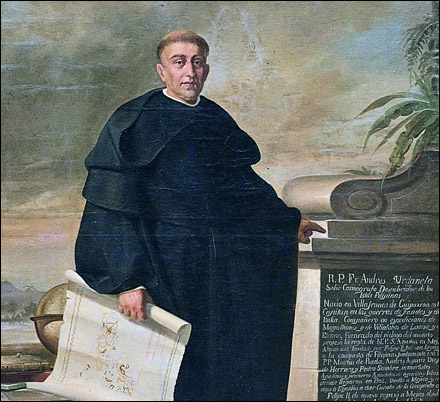
Friar Andres de Urdaneta

Magellan’s Expedition showed the need for an International Date Line to be established. Upon their return had found that they were actually one day behind the actual date of their return, eventhough they had faithfully maintained the ships’ logbooks. The had lost one day because they travelled west during their circumnavigation of the globe, the opposite to the earth’s rotation. This caused great excitement at the time and a special delegation was sent to explain this oddity to the Pope.
And in closing, a replica of the Victoria, Magellan’s only surviving ship, can be visited in Puerto San Julian, Argentina.











You must to post a comment.