

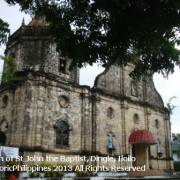
St John the Baptist Church was was built by the Augustinians under the direction of Friar Fernando Llorente between 1865 and 1886. As with all other Augustinian churches in the region it was built under the ‘folio’ system or forced labour. The actual settlement and church at Dingle were actually originally established by Augustinian Friar Blanco under the name Ba-ong as a visita of Pototan in 1593. Although Friar Blancoi headed a ‘visita’ or chapel under the jurisdiction of Pototan, he was able to act quite independently.
During the 1600’s, specifically in 1627 and later again in 1634 the settlement was ‘depopulated’ as a result of incursions by Aetas (Panay Negritos) who destroyed the surrounding farms and killed most of the settlement’s residents.
The church was in fact constructed to replace the chapels which had served the settlement for close to 300 years.
It was built under the direction of Friar Fernando Llorente between 1865 and 1886. As with all other Augustinian churches in the region it was built under the ‘folio’ system or forced labour.
In fact the entire male working population were forced to work on the church construction between 3 and 6 days per week, without pay. This of course caused great hardship on the population in general. Any violations of the works orders of the priest were most often handled in an unusually harsh manner. Punishments ranged from floggings, being forced to stand under the hot sun, even having to stand over an ant hill and in some rare cases, excommunication.
Friar Llorente ordered that all the people of Dingle through their “Capitan del Barrio” to deliver a bag of sand and a basket of stones every time they entered the village. He also ordered that the local ‘indios’ harvest all first class trees in the area of Mounts Bulabog and Manyakiyato be used in the construction. Sandstone blocks were cut and transported into the village from nearby Mounts Bulabog and Tinocuan on sleds or carts hauled by caribaos or ox teams.
The St John the Baptist Church is built mainly of limestone blocks.
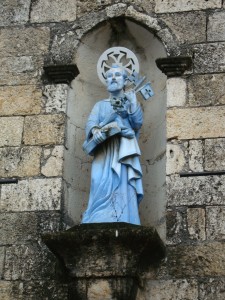
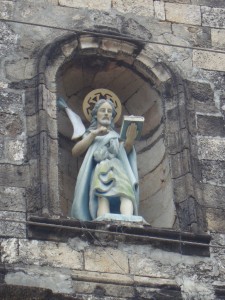
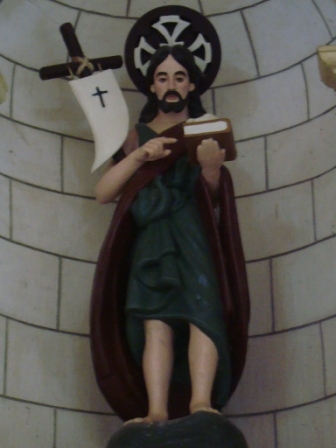
The façade has three niches. One to the left of the main entry which houses a statue of Saint Paul and to the right a statue of Saint Peter. Above the entrance is the third niche with a statue of St John the Baptist – the patron Saint of the town and church.

In addition, there are four oculi in the façade wall above the niches previously mentioned in which there is beautiful stained glass rendering of The Blessed Virgin Mary, The Sacred Heart of Jesus, Saint John The Baptist and the Lamb of God. This latest one being located on the second level of the east side/main façade of the bell tower.
The canopy over the main door is a recent addition and honestly, it looks a little out of place on the front of such an imposing building.
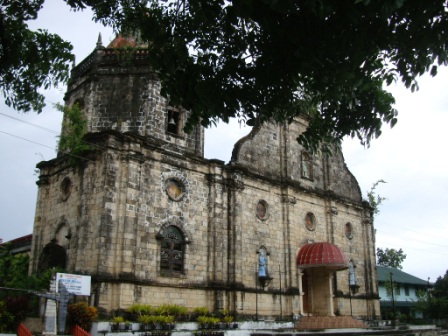
Facade showing the Oculi and Canopy
Almost hidden by the canopy, directly over the main doors, is a date stone that indicates the year in which the church was completed. It reads “Año 1886”.
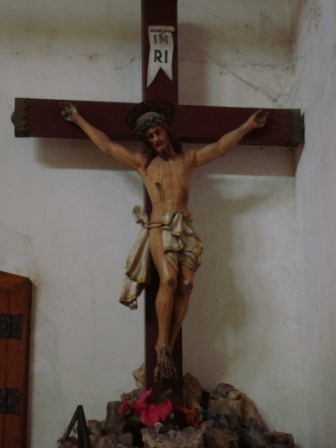
Upon entering the main church we notice to the right a life sized statue of Jesus Crucified.
To the right as we enter the church is the Baptistery – the baptismal font is noteworthy because of its sheer size – it is over a meter in diameter.
Overlooking the entire room is a small wood carving of Saint John the Baptist. Along the south wall is a stairway leading to the bell tower.
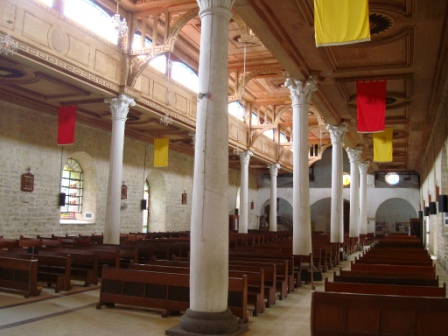
Back into the main area of the church we are struck by the magnificent woodwork throughout the church particularly the ceiling. Here is a view of the church from the sanctuary towards the main entry.
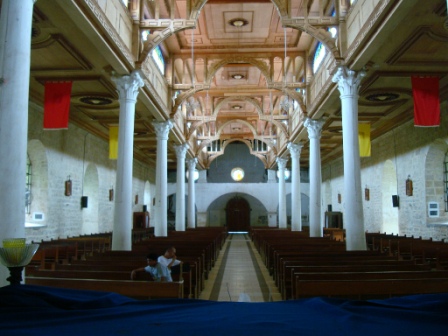
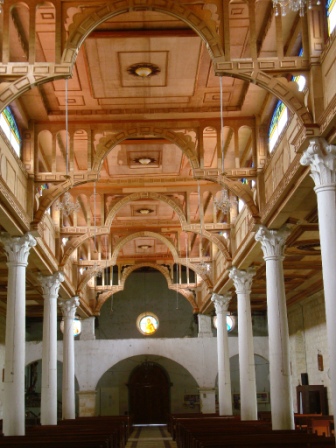
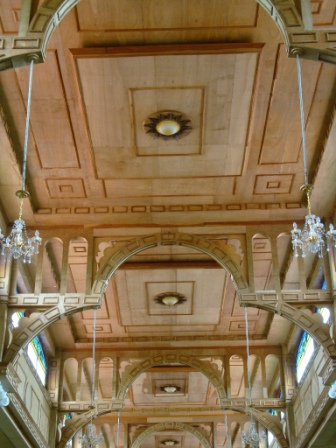
Note the beautiful paneling on the ceiling (close up shots below). It is a true work of art.
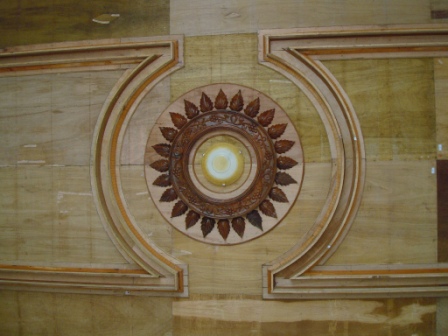
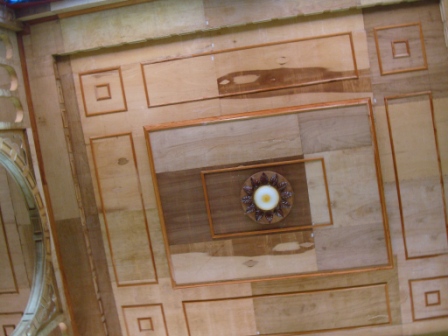
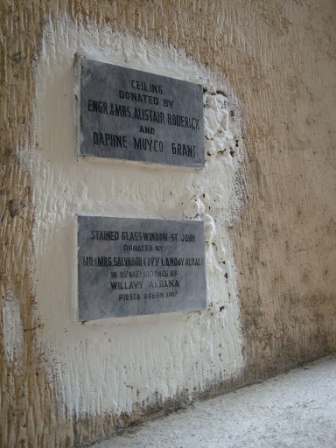
When we move forward towards the Sanctuary, the windows strike us, again, as works of art. They are stained glass windows depicting some of the Saints, more specifically the Evangelists: Saints Matthew, Mark, Luke and John. All donated to the church by various parishioners.
The Sanctuary is on a raised marble dais and is very impressive with its columns and stonework including the niche housing another statue of Saint John the Baptist.
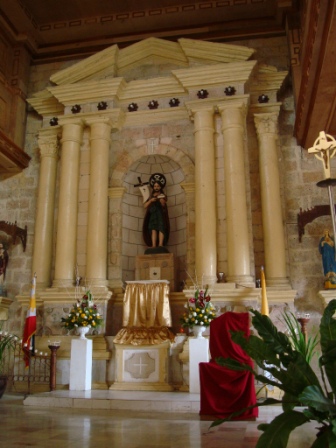
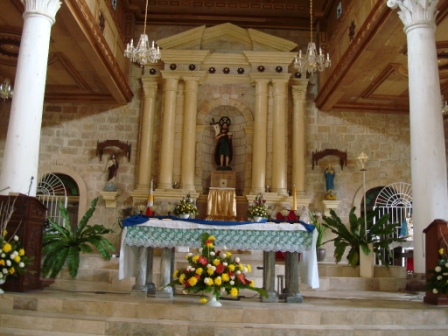
The two doors on either side of the altar lead into the sacristy and to an exit leading into the church’s lush, verdant side yard and where we’ll find the bell tower which was seriously damaged in the Lady CayCay earthquake of 1948.
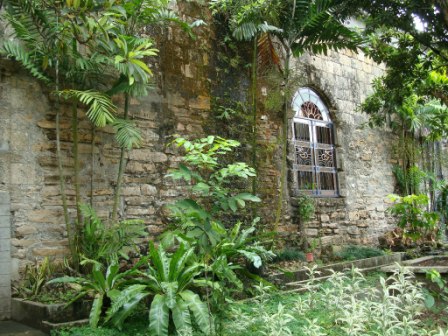
Lush greenery in the side yard
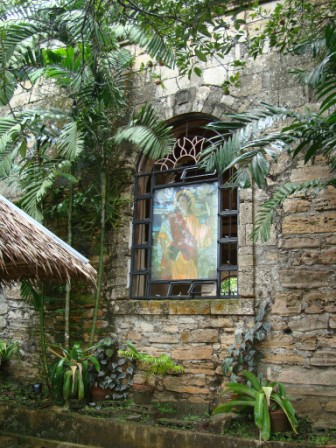
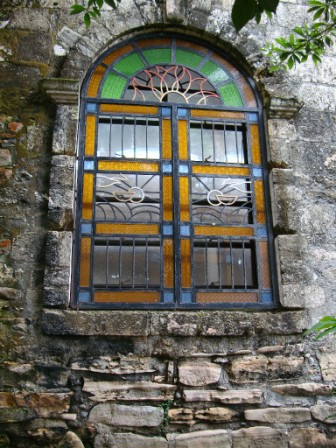
Fortunately, the earthquake damage was limited to the bell tower which was later repaired between 1980 and 1986 just in time for the church’s centennial celebrations.
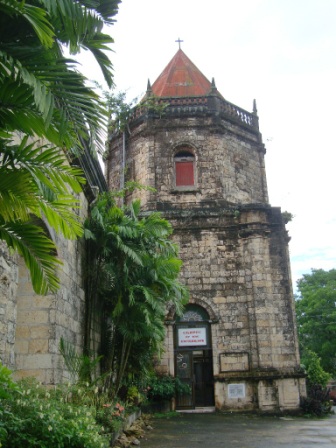
A view of the Bell Tower from the side yard
On approaching the bell tower entrance we find that the ground floor houses the parish’s Adoration Chapel. The wood work in the Adoration Chapel is locally grown and carved hardwood called ‘hamor-awon. The hamor-awon or molave is symbolic of strength, durability and beauty’. The Chapel is simple, small, intimate and quite beautiful.
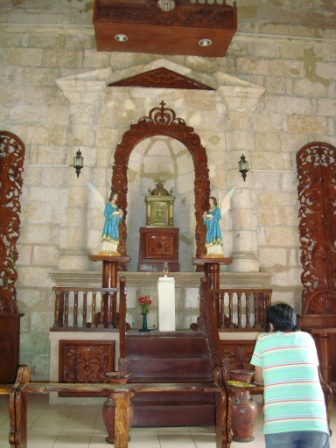
At prayer in the Adoration Chapel
As we step out of the Chapel and just turn the corner and view to north side of the Tower we find a Grotto of Our Lady of Fatima just under another oculi, above it we can see one of the two bells occupying the tower.
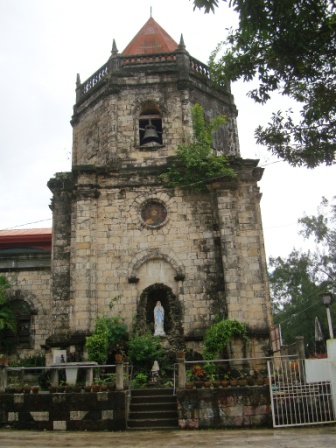
And just across the parking lot from the tower and next to the Convento and Parish Centre there is another Grotto, this one dedicated to the Birhen ng Barangay (The Virgin of the Barangay).
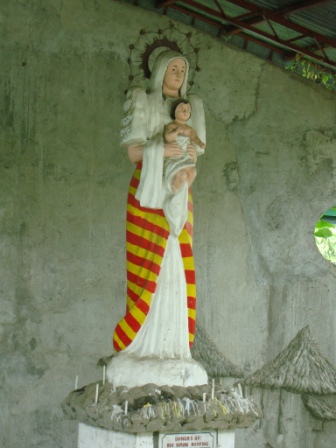
The Virgin of the Barangay
During the Revolution against Spain, Dingle staged the first armed uprising in the Province of Iloilo. This occurred in Barrio Lincud on October 28, 1898 and is now known as the “Cry of Lincud”.
Adriano Hernandez, Julio Hernandez, and Nicolas Roces led the uprising. Hernandez subsequently became a brigadier general and represented the province at the Malolos Congress. Later, he was appointed Secretary of Agriculture.
He led a force of 600 revolutionaries against both the Spaniards and later the Americans. The revolution supposedly ended in March of 1901 when General Aquinaldo (the President) was captured by the Americans in Palawan. But Hernandez and his band of guerillas continued to harass the Americans until finally surrendering in 1906. Today, his statue graces the town plaza and Dingleanons regard him as their hero.
The town didn’t fare much better under the Japanese during World War II. The area, specifically the foothills surrounding the town, became the refuge for several families fleeing the occupation of Iloilo and other major centres. There were serious incidents during the occupation two of which we will only very briefly outline because of their connection to the church.
- Close to the war’s end the Village (Poblacion) the public market started to operate once again. On day, by chance, a squad of Japanese soldiers happened by the market, spotted the men who were busy selling goods at the market and arrested them all on suspicion of being guerrillas. There were 14 of them picked up and shortly thereafter they were summarily executed by beheading in the yard behind the church.
- In 1942 the resistance burned all the houses and public buildings in the Poblacion to deny the Japanese their use and especially to prevent them from setting up a permanent garrison in Dingle. The Church and the Marketplace were the only two structures spared in this fire.
After liberation, the Poblacion was in total ruins, except as for the Public Market and the Church which had been spared. We must remember that this destruction was the result of guerrilla activity rather than that of the Japanese occupation forces. It took almost 10 years to rehabilitate the town and by 1951 substantial growth in the area was becoming apparent and the town was well on its way back.

The magnificent old church of St John in Dingle

This work is licensed under a Creative Commons Attribution-ShareAlike 3.0 Unported License.



 Philippine Peso Exchange Rate