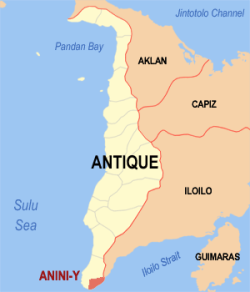
 The driving distance from our jumping off point at the SM City parking lot in Iloilo to the church in Anini-Y is approximately 72 kilometres. Which translates into a driving time of about 1½ to 1¾ hours.
HP HERITAGE RATING:  for more information click here
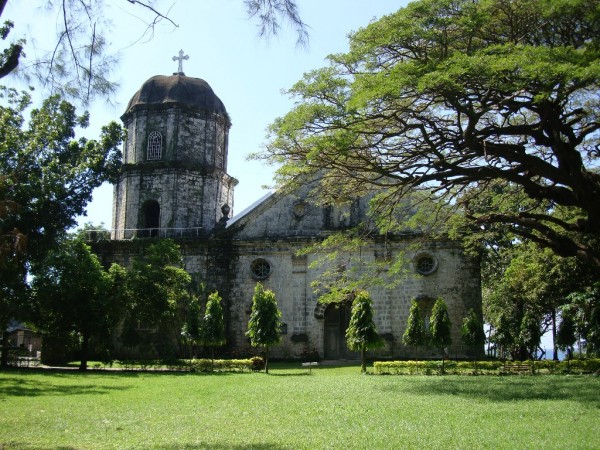
Anini-y has the only preserved colonial church in Antique.
Anini-Y was established as a fishing village by fishermen who came from Asluman, a barrio of Hamtic sometime between 1600-30. Hamtic was the oldest settlement in Antique and was under Augustinian administration from 1651, when Friar Miguel de Siguenza was appointed minister.
Anini-y was a visita of Hamtic and priests from the mother parish would visit the settlement on their mission tours that brought them as far as the Cagayancillo Islands in the Sulu Sea. Augustinian Friars Hipólito Casimiro and Felíx Roja y Zuñiga were the two priests credited with organizing and evangelizing Anini-y in the 18th century.
Anini-y became an independent parish on 22 March 1862, in accordance with a papal decree on 20 December 1861. The first Augustinian parish priest was Friar Romualdo Crespo who was appointed in early 1862.
This gem of a church is the third built in the town.
The first was probably built by Frair Hipólito Casimiro, between 1630 and 1638. The church whose foundations still exist measured 33 x 13 meters. A second church of much greater length but narrower at 48 x 12.5 meters was constructed close to the earlier church.
Work on the current church began around 1845. Friar Jeronimo Vaquerín was responsible for completing the present complex, the convento in 1879 and the church, except for the arco toral, was almost completed when the Augustinian left in 1898. Friar Vaquenn was the parish priest from 1878 to 1898. The church was vacant during the Philippine Revolution (1898 – 1902). It was taken over by the Aglipayans in 1902 until it was returned to the Catholic Church and the Mill Hill Missionary Fathers in 1908.
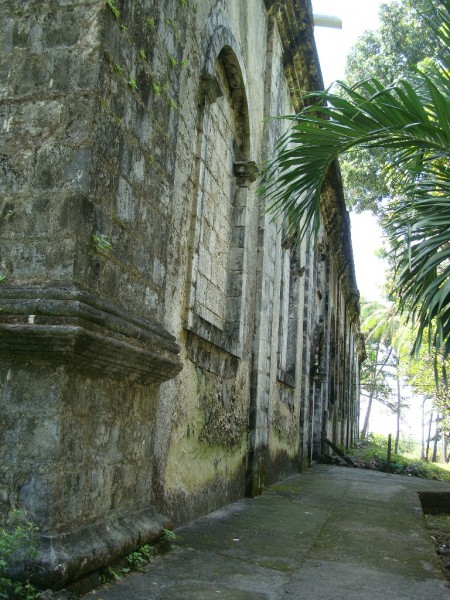
The church belongs to 19th century revivalist styles, incorporating traditional elements from the Baroque like the triangular pediment, supported by a single story, divided into there sections by engaged pilaster. The photo below shows the pilasters along the side of the church facing the convento.
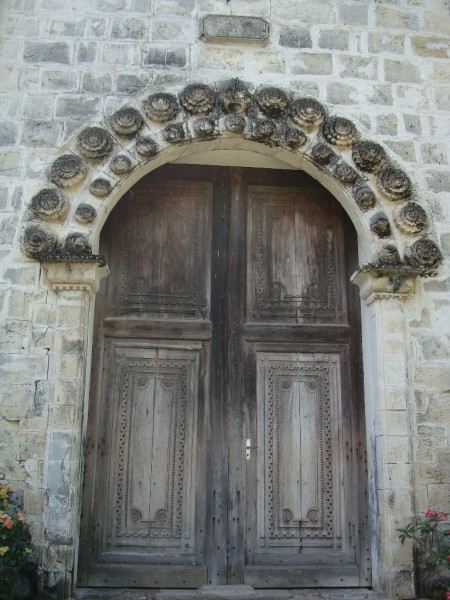
Between the central pilasters is the arched entrance to this single-naved church, pleasingly decorated by rosettes. Flanking the entrance are expanses of wall decorated by niches above, which are rose windows. The pediment is likewise ornamented with a niche and flanking blind occuli. The facade comes to an end in stout pilasters ornamented above with finials.
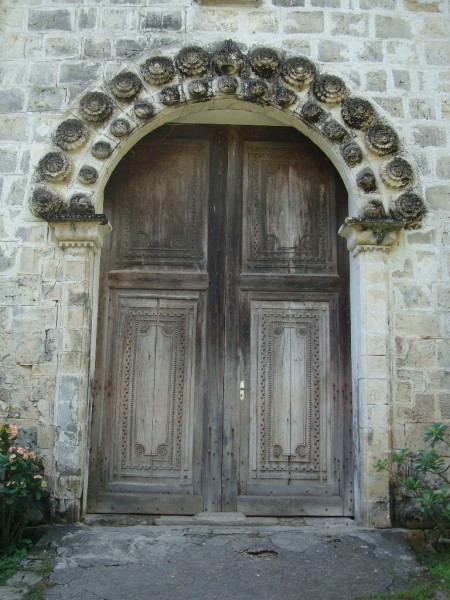
Main entrance
The three-story bell tower is attached to the church; its lowest floor is quadrilateral while the upper floors are hexagonal. Arched windows pierce the tower and a domical roof crowns the whole structure. (Panublion)
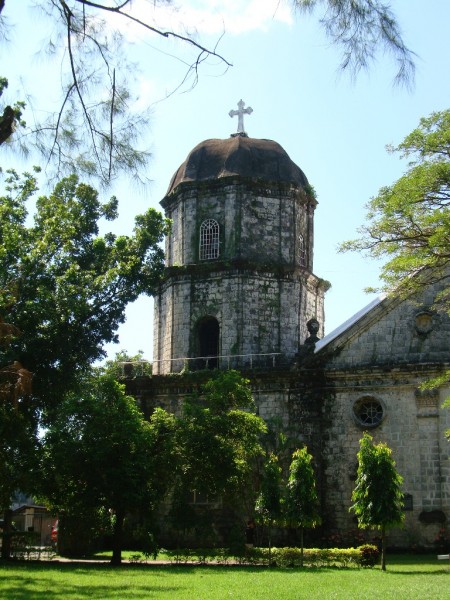
The Bell Tower
It is generally constructed of coral and stones collected in the immediate area. A look at the construction materials on the exterior clearly shows this.
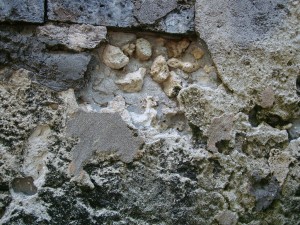
coral and stone construction materials
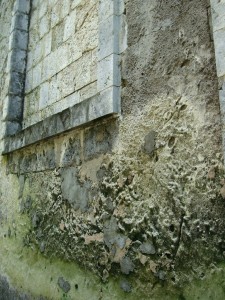
more coral and stone of the wall construction
A closer look at the backside of the bell tower shows more construction material details.
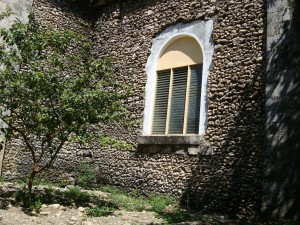
more stone work on the back to the bell tower
Much of the construction related materials was collected from the vicinity of the beach close by the church as seen in this photo.
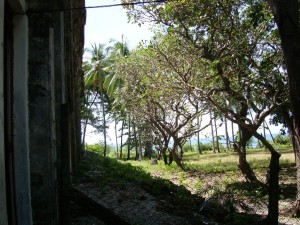
the beach front just behind the church
On entering the church by the side door, we were amazed by how clean and bright it appeared. Obviously the parish takes pride in their church and repair or refurbishment work is constantly in progress.
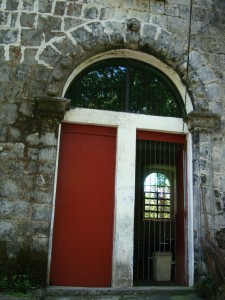
Side entrance
This being a single nave church we immediately walked up to the sanctuary and marvelled at how simple and beautiful it is with the entire back wall appearing to be constructed with large pebbles completing the arco toral…
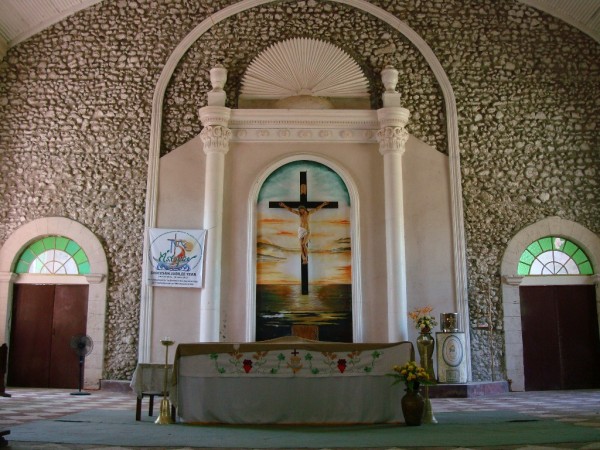
The Sanctuary
Simplicity appears to be the rule in this church and it contrasts magnificently with the other more ornate churches we have visited.
Walking towards the back of the church we find along one wall a church bell which was, according to its inscription, cast in 1898. It is ‘stored’ here we presume due to repairs being made to the bell tower.
A little closer to the back of the church we find the Baptistery with its original baptismal font all overlooked by an ornate niche in the wall containing a beautifully carved Crucifix.
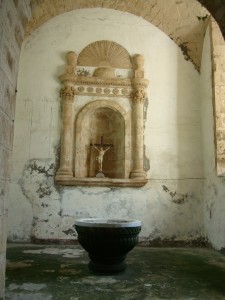
A closer view of the niche shows how really beautifully done the work of restoration has been lovingly and caringly done by the Mill Hill Fathers.
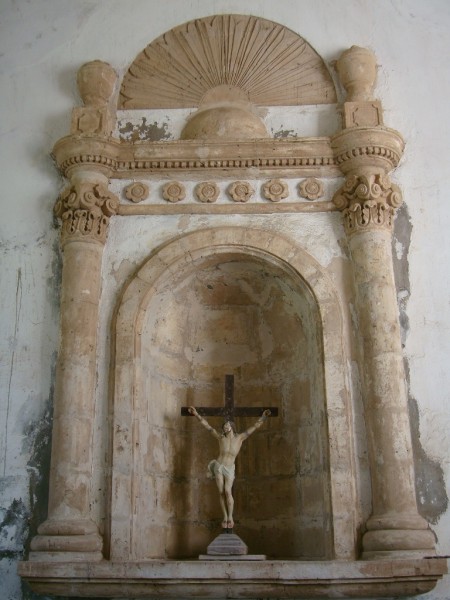
The beautiful stonework & crucifix in the Baptistery
Unlike many of the church we have already visited, this church is refreshing, if you can say that of a church, because it is not encumbered with tens and tens of statues. It has only 5 or 6 beautiful statues including:
St John of Nepumuceno, the patron saint of the parish.
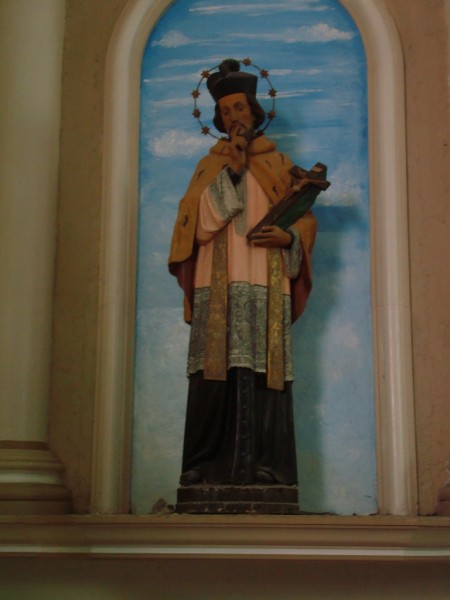
St John of Nepumuceno, Patron Saint of the Parish
A statue of St Theresa (I believe).
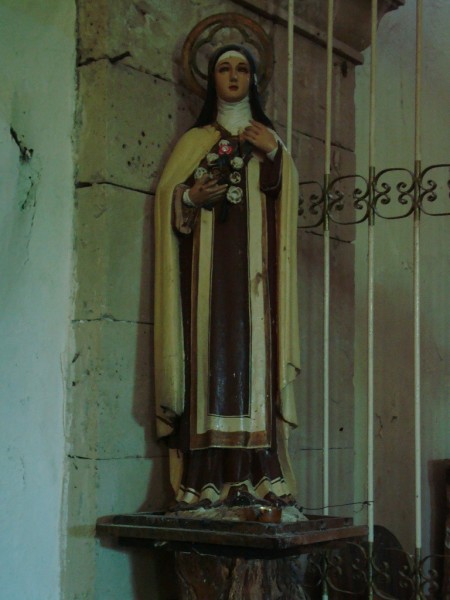
St Theresa
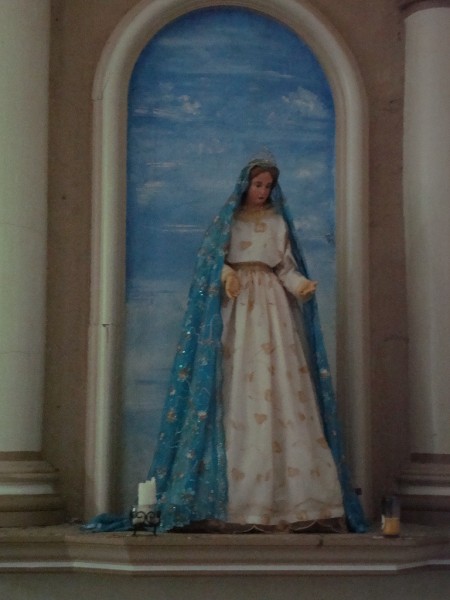
And finally the Blessed Virgin Mary.
As mentioned earlier the original Convento was completely destroyed during the second world war and it was not rebuilt until the Mill Hill priest Father William Erickweld preserved the ruins and built a new and modern convento adjacent to the ruins during the early 1970s. In 1973, the roof of the church roof and the back wall were seriously damaged by a typhoon and once again Father. Erickweld restored the church once again.
In 2008, the National Museum of the Philippines named the Church a National Historical Treasure. Even today, there is a drive to raise funds for more restoration and refurbishment work that is projected for the church and its adjacent buildings in the coming months.
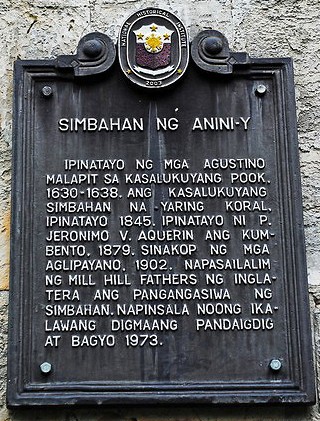
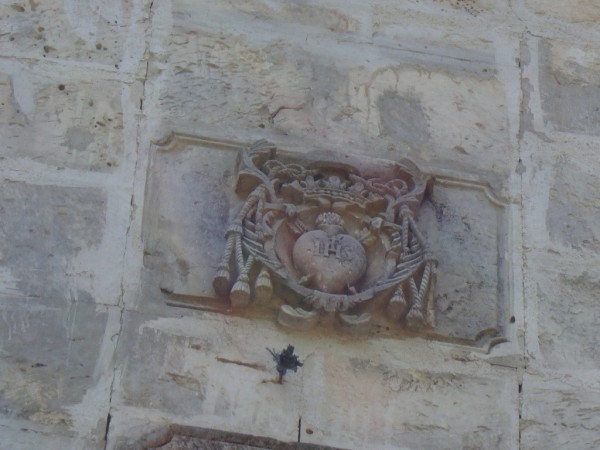
This is the only Spanish era church in Antique Province that was originally built by the Augustinians Friars. And we know that because of the Augustinian seal over the main entrance door.

This work is licensed under a Creative Commons Attribution-ShareAlike 3.0 Unported License.



 Iloilo Time